Improve Your Mobile Photography with 20 Tips!

Do you want to take excellent photos with your mobile phone?

Mobile photography may seem daunting. But with a few simple tricks, you'll be able to shoot better photos with a WoW factor
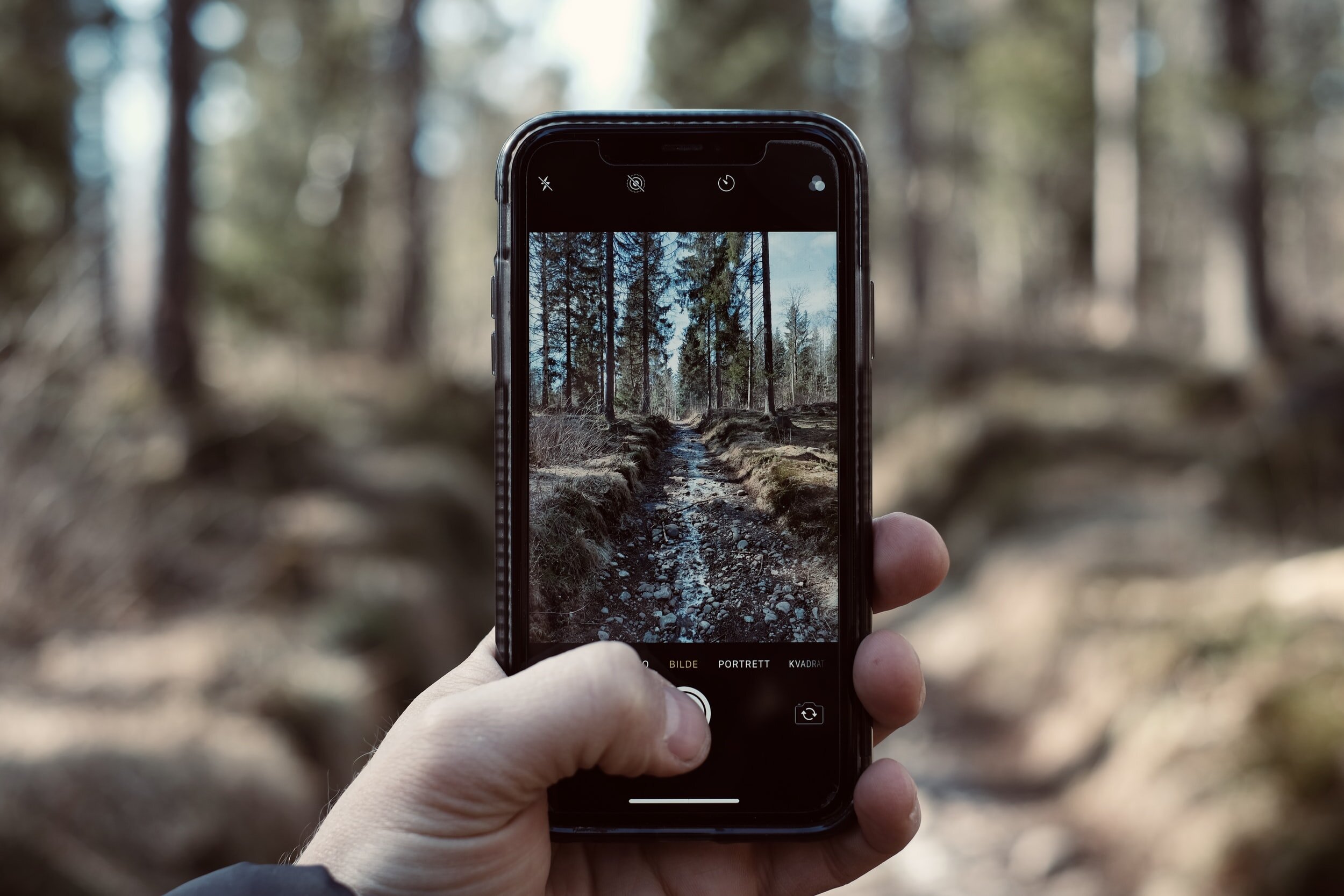


1. Clean Your Lens to Get Sharp Images

The first and most important thing every mobile photographer should do is clean their phone lens.

Make sure you wipe the lens before taking the shot to get crisp, clean images.

We carry phones in our pockets and bags, which are havens for dirt. Always make sure you give your lens a quick wipe before you take any photos.

Specks of dust on the lens can ruin the perfect shot; it can make an image fuzzy or cause potential light distortion.

Your camera lens needs to be clean to capture clear and crisp images like this.


2. Explore Your Camera Settings

The best phone photography happens once you have familiarised yourself with your mobile’s camera settings and features.

Check your manual, phone settings and native camera app to see what your mobile has to offer.

The number of options available will vary depending upon your phone’s make and model. Learn how to access these features quickly and confidently, so you always get the best possible shot.

Familiarise yourself with your mobile camera settings so you can access them quickly.


3. Set your Image Quality to High

Make sure you have the image quality set to the highest possible level in your settings. This ensures you are using the camera to its maximum capabilities.

Set the image quality to the highest possible level to capture beautiful details, such as these dandelion clocks, taken with an iPhone.


4. Get Beautiful Bokeh Effect in Your Photos by Using Portrait Mode

A fairly recent addition to some smartphones has been the portrait mode in the camera app.

iPhones and Google Pixel phones have this handy mode, which blurs the background on portrait shots. It adds depth of field to images by mimicking a professional camera lens.

Use portrait mode to blur the background.
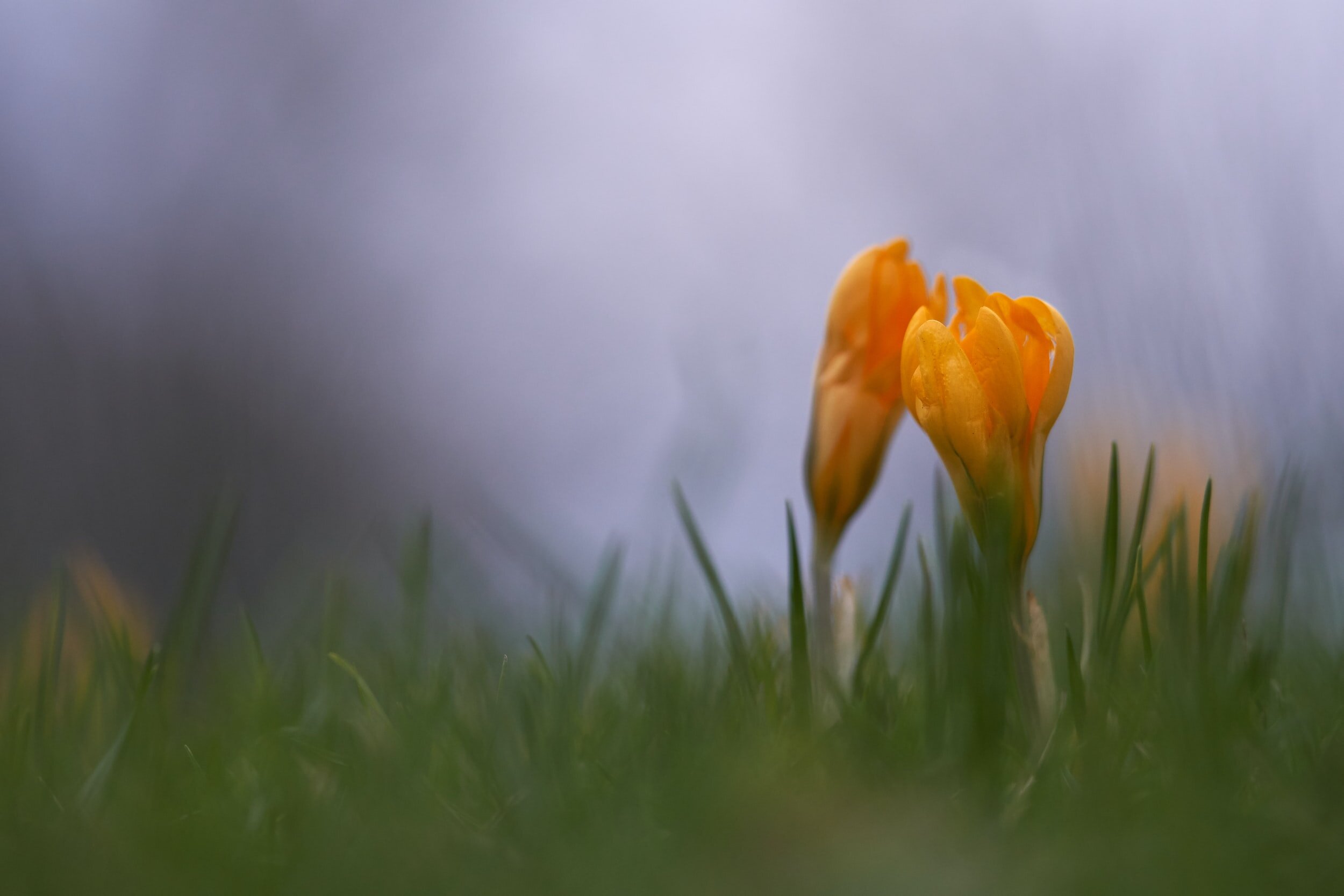


5. Sweep Your Phone Sideways to Create Panoramas

Turn on the panorama mode in your camera app to capture beautiful sweeping landscapes.

Vistas like this won’t last long. Use the panorama setting on your phone to capture the whole scene.

Pan your phone to the left or right to take the photo. Your phone takes a series of shots which it then automatically stitches together to create one long panoramic image.


6. Capture Great Action Shots with Burst Mode

The burst mode in your camera app allows you to take multiple shots in quick succession. This is great for capturing action shots of people or pets. You can scroll through the shots to pick the best one.

Capture actions shots using the burst mode on your mobile.


7. Use the Self Timer to Ensure Sharp Images

Use the camera’s self-timer when light levels are low or you need to steady the phone. Find a tripod or prop your phone on something and set the self-timer running–it usually runs at intervals of 3 or 10 seconds. The use of this will minimize the risk of camera shake and you’ll end up with a sharper image.

Use your phone’s self-timer for sharper images in low light conditions.


8. Don’t Compromise on Quality – Forget the Front Lens

There’s one phone function you’ll be tempted to use but should avoid: the front camera lens.

The image quality is generally much lower than your phone’s rear camera, which could result in noise on your image, especially in low light situations. So, avoid the temptation, even if composition with the rear lens is a bit trickier!

Avoid the temptation to use the front-facing camera lens: the image quality will be poor.


9. Uncover Camera Shortcuts to Quickly Access Features

Time is of the essence with photography to ensure you don’t miss the moment. Good knowledge of how to access your phone camera quickly is vital. There’s usually a shortcut that will let you bypass the phone’s lock screen.

In the iPhone, swipe left to access the camera directly from the lock screen.

Did you also know that on an iPhone you can use the volume buttons as shutter buttons? This offers a discrete option that is perfect for capturing candid moments.

Use the volume button as a shutter button to capture candid moments.

It’s also much easier to use the volume buttons as the shutter if you only have one hand free: perfect if you need to hold your subject in position with your other hand.

Take the time to discover the shortcuts specific to your phone model to improve your mobile photography.

Quick access to your camera app means you won’t miss moments like these.


10. Hold your Mobile Steady to Stop Camera Shake

It’s extremely important to hold your phone still when taking a shot. This will ensure the final image is sharp.

You could use a tripod to achieve this: there are plenty available to fit mobile phones. However, one of the advantages of mobile photography is you don’t have to carry extra equipment.

You can rest your body on the ground to keep your phone still to get shots like this.

A simple tip to steady your phone is to rest it against any kind of fixed surface when you press the shutter. A table could work if you are indoors, or alternatively, a rock or a tree stump if you are outdoors.

, or alternatively, a rock or a tree stump if you are outdoors.

You can also steady yourself. Try leaning your body or arm against a fixed surface to stop your phone moving when you take the shot.

Steady your arm and phone against objects such as trees, for shots taken in low light conditions.

It is especially important in low light conditions to keep your phone steady. Holding your phone close to your body can also help reduce camera shake.

It’s important to keep your phone steady when taking shots in low light conditions.


11. Take Control Of Focus to get Tack Sharp Images

Most mobile phone photos tend to have a wide depth of field, which means a sharp focus throughout the scene.

Controlling the focus plays a big part in being creative. Get your camera lens up close to a subject in the foreground to create a narrower depth of field; the background will then drop out of focus.

Focus on the foreground to narrow the depth of field.

Pro Tip: Remember to tap the screen at the point where you want the focus to be sharpest.

If you struggle with that or don’t have portrait mode on your mobile, you can blur parts of an image in post-processing. Make use of photo editing apps and software to achieve this.

Create a shallow depth of field by focussing on a subject in the foreground.


12. Turn On The Gridlines to Perfect Your Composition

The composition is key to a good photo, whether that is taken on a traditional camera or your smartphone.

Nothing screams amateur photographer more than an uneven horizon.

But this is easily avoided with one simple trick: turn the gridlines on in your settings.

Use your on-screen gridlines to make sure subjects, like this bridge, are straight in your shots.

This will overlay two horizontal and two vertical lines on your screen. Line these up with elements of the scene to make sure everything is straight.

Use the grid lines to line up elements of your scene, to ensure everything is straight.


13. Adjust The Exposure for Beautifully Lit Images

Phone photography is not just about pointing and shooting. You must adjust the exposure to get a good shot.

Exposure is the amount of light that reaches your camera sensor. This is crucial in determining how light or dark your final image will be.

You may need to adjust the exposure on some shots to lighten the foreground.

In traditional photography, the amount of light reaching the camera sensor is adjusted by changing the aperture size.

In phone photography, we can’t do that. One method is to tap to set the focus in a particular part of the scene. If you tap and focus on a light area–such as the sky–the camera will adjust the exposure to try to match darker parts of the scene. This will give you a darker image.

Tap your screen to focus on the sky, which will darken the foreground and give an intentionally moody feel to your shot.

Alternatively, focus on a dark area–such as the foreground–for the camera to try to match the lighter areas of the scene. This time you’ll end up with a lighter image.

Try focussing on different parts of the screen to get the overall image brightness just right.

Some models of mobile phones have manual exposure control (exposure compensation), which appears when you tap and focus on the screen.

Click on your screen to activate the focus. Then look for an exposure slider that can be adjusted to correct your exposure.

In the iPhone, you’ll see a sun icon appear next to a vertical line. Drag your finger upwards across the screen to increase exposure, or downwards to decrease exposure.

Tap on different areas of your smartphone screen to get the right level of brightness/exposure.


14. Turn HDR Mode On to Help Exposure

Have you ever wondered what the HDR mode does on your phone? You’re not alone. Many people overlook this setting, but this can help with exposure.

HDR stands for High Dynamic Range. It’s especially important to turn HDR on to make sure your photos are perfectly exposed.

This iPhone shot with HDR mode on captures all the detail in the both the dark and light areas of the scene.

Landscape photography shots that are taken on a mobile camera often suffer from an overexposed sky and dark foreground. The HDR setting should help fix that issue.

HDR enables your camera to take several photos in quick succession; some are lighter and some are darker. Your phone then combines these to give one better-exposed image.

However, don’t use this setting if your subject is moving, as you’ll get end up with a blurred image.

Most phones will give you the option to keep both the normal and HDR version of a shot.


15. Always Look for the Best Lighting for your Shot

Mobile phone cameras generally don’t perform well in low light conditions. You’ll end up with grainy images and unwanted blur from camera shake.

Try to shoot in natural light wherever possible.

The golden hour before sunrise or after sunset, is a fantastic time to shoot. It gives more even exposure and a lovely warmth to shots.

Shoot during the golden hour to add a lovely warm glow in your images.

Try to avoid harsh sunlight in the middle of the day: this will cause unwanted shadows, light spots or glare on your image.

Overcast days and misty weather, on the other hand, even/soften the light and are a great time for mobile photography.

A misty early morning can produce beautiful soft light.

Avoid using your mobile’s built-in flash: it’s rarely flattering. Related Article: Ultimate Guide to Flash Photography


16. Move Closer to your Subject to Maintain Image Quality

Avoid the instinct to use your smartphone camera’s zoom function. It is a digital zoom, which reduces the quality of the final image. It is the editing equivalent of cropping an image.

If you want to capture more detail, simply move closer to your subject. You will retain far more pixels image and detail in the image than if you zoom in.

Move close to your subject, rather than zoom in, to ensure no loss of quality of the final image.

The only exception is if your mobile has an in-built optical zoom. This usually means you’ll have a second lens, as well as another fixed focal lens. One example of this is the telephoto lens on the iPhone XS.

Get in close to subjects to retain more detail.


17. Change Your Position for a New Perspective

A huge advantage of mobile photography is a small size and the lightweight of your camera. You’ll be able to manoeuvre yourself to take photos from angles you may not have ordinarily tried.

Try a different angle with your phone photography.

Turn an ordinary subject into something special by looking at it from a different perspective.

Get down low and shoot at ground level. You’ll be able to include foreground that helps set the scene for your image, which will add interest and draw the viewer in.

Crouching down low and including the foreground, adds depth to an image.

Shooting upwards is a great way to make your subject appear imposing and larger than life. Remember to move yourself as well as your mobile camera to find the best perspectives.

Shooting upwards adds a new perspective and can make your subject seem imposing.


18. Try Third Party Camera Apps for More Creativity

Are you craving more advanced control of your mobile camera?

The beauty of mobile phones is you don’t need to spend lots of money to enhance your photography kit. Simply find a third party app, which will give you new camera tools.

If you’re an experienced photographer there are apps available that will match the capabilities of your main camera.

Third party camera apps will give you more control in difficult lighting conditions.

You’ll find apps that offer a broad range of manual controls such as ISO, white balance and focus. While other apps are dedicated to a specific task, such as long exposure photography.

There are also plenty of fun effects apps too. These can do all kinds of things from adding fun stickers to your images to turning your shot into a cartoon.

Head to the Apple App Store or Google Play Store to browse the camera apps on offer.

Unlock more advanced manual controls for your phone camera with a third party camera app.


19. Use Phone Photo Editing Apps to Add Flair to your Photos

One of the best things about mobile phone photography is that your creativity can continue after you’ve taken the shot.

There are many editing apps available to help you add more flair to your images. Plus you can edit instantly on your phone, with no need to transfer shots to another device to edit.

The mood was enhanced on this image with the use of a phone photo editing app.

Start by cropping and straightening shots to refine your photos.

If you’re new to editing, try Snapseed. This app, available to iPhone and Android users, offers plenty of editing options including a blemish removal tool. It also features a great selection of overlays to add to shots, which change the look of your image.

Read Next: Best photo editing apps

If you want to turn your photo into a painterly masterpiece, Mextures (iPhone only) is a great introduction to layer-based editing.

An iPhone photo transformed into a painterly work of art using the Mextures app.

Or, turn your photos into a work of art with a single tap, with the Prisma app (iPhone and Android).

Some apps even magic away unwanted telephone lines, or light flare from the sun, with a single tap.

Have fun and get creative by adding mobile editing apps to your mobile photography.

A black and white filter was added to this iPhone shot for a simple edit.


20. Take Lots of Photos

Don’t let a lack of storage space on your phone prevent you from taking photos.

Take plenty of shots of the same scene from different perspectives.


The mystery of Scottish "witch" Maggie Wall

Just outside the village of Dunning in Perthshire, lies a monument. It’s a collection of stones about 20 feet high, topped with a cross and decorated with gifts left by visitors—pennies, feathers, shells, fluffy stuffed animals, and tiny tea candles. The stones bear the words in stark white lettering: “Maggie Wall burnt here 1657 as a witch.”

Maggie Wall1.jpg

Scotland was home to nearly 3,800 people accused of witchcraft between 1500s and 1700s, the vast majority of whom were women. In the end, about 1,500 were murdered as a result of witch hunt inquisitions. However, mysteriously, there is no record of a woman named Maggie Wall being tried as a witch. What’s more, there’s no record of the monument itself until 1866, though a forest surrounding the monument called Maggie Walls Wood was documented as of 1829.

There are several theories about who Maggie Wall was and why her monument exists. Some have suggested that Lord Andrew Rollo (the landowner of the area at the time) was having an affair with Maggie, and built the monument after she was executed out of guilt.

Others theorise that it was in fact Lady Rollo who erected the monument, feeling a sense of sympathy towards Maggie and women like her.

In 1663, six women from Dunning were accused of witchcraft (and three were executed), which is an alarmingly high number considering the village only had a couple of hundred residents.

The 1650s and 1660s were turbulent times in this Perthshire parish, with the witch trials coinciding with religious and political tensions.

The local minister, Revered George Muschet, was deemed unfit by church officials, but he was well liked within the village. When officials attempted to discipline the minister in 1652, they were attacked by an angry mob of local women who wanted to keep him in the church.

Some have suggested that Maggie Wall was part of this group, and that may be why she came under the wrath of the church and burned as a witch a few years later.

The accepted theory is that this monument stands as a testament to all the witches murdered in Scotland during the witch hunts as no other such monument exists. Perhaps the name was taken from the surrounding wood to represent the countless and forgotten women who were killed. Occasionally a wreath is laid at the foot of the monument, serving as a reminder of the injustices suffered by the mysterious symbolic witch, Maggie Wall.

Before You Go

This monument is located right outside of Dunning Scotland. Dunning is in Perth and Kinross. It is off of the road B8062 which you can access from the A9 highway.

Rural Life in Monochrome

Rural areas have a low population density and small settlements, also agricultural areas are commonly rural, as well as other types of areas such as forests.

Different countries have varying definitions of rural for statistical and administrative purposes……but no matter where the style of life is very similar

Rural living offers the opportunity to reconnect with nature. More trees and less traffic means cleaner air. Fields, forests, and streams make for great outdoor living and a healthier lifestyle

Advantages

  • More privacy. In the countryside there’s a good chance your nearest neighbour won’t be directly next door. You may not even be able to spot their home at all.

  • You can have a bigger garden. If you’ve always wanted to grow your own food or have more space for children or pets, this is a huge benefit.

  • You’ll be able to own pets you may have always wanted but couldn’t have owned in a city or town. Cows, llamas and horses are all examples of these. You could even keep hens and have your own free-range eggs.

  • You’ll be closer to the various wildlife of the area and to walks in areas of natural beauty.

  • City-dwellers usually suffer higher levels of stress than those who commute in for work or live and work in the country. There is a reason living and working in a city is called “the rat race”. By decreasing the number of people surrounding you, you could become more relaxed.

  • You can be fully, or semi self-sufficient. You could grow your own food. If you do decide to keep animals, you may also be able to sell produce from them (milk/eggs/honey) to create a small income.

Disadvantages

  • If you have children of school-age, they might be faced with a longer journey to school, whether they walk, take the bus or get a lift in.

  • Shopping can become an inconvenience. This may not seem all that important, but staples that are purchased a couple times a week, such as milk and bread, may be further than just a 2 minute trip down the road.

  • There may be limited job opportunities, unless you already have a job nearby or if you commute into a town or city.

  • Television and Internet connectivity could be weaker or patchy in more rural areas.

  • During the winter months, nearby roads might not be in the best shape or not be as well maintained as urban roads.

  • Trade services, such as a mechanic, are harder to find. In urban areas, if you have car trouble you can make do with a local taxi or bus until it’s fixed. Services like these are scarcer in the countryside, leaving you with limited options.

  • Entertainment and eateries may be further away, which involves more time, a higher expense and extra planning.

Sufi Galata Dervishes

The Mevlevis are also known as the "whirling dervishes" due to their famous practice of whirling as a form of dhikr (remembrance of God). Dervish is a common term for an initiate of the Sufi path; whirling is part of the formal sema ceremony and the participants are properly known as semazens.

The Galata tekke has a long and revered history, having been founded in 1491 by a Ottoman grandee from the palace of Sultan Beyazit II. The tekke’s first şeyh(sheikh, leader) was Muhammed Semaî Sultan Divanî, a descendant of Mevlâna Jelaleddin Rumî himself.

The building you see is not the original, which burned in 1765, but its replacement, which dates from 1796 and was extensively restored during the 19th century, also between 1967 and 1972, and again in 2008.

The Galata Mevlevihanesi Müzesi is open daily except Monday from 09:00am to 16:30 (4:30pm), with last entry at 16:00 (4pm). There is a small admission fee.

Galip Dede, a renowned 17th-century sheikh of this tekke, is buried in an ornate tomb to the left as you enter from the street.

Kumbaracıbaşı Ahmet Paşa, better known in the west as Claude Alexandre, Comte de Bonneval (1675-1747), a French nobleman who converted to Islam and entered the sultan’s service as a bombardier general, is also buried on the tekke’s grounds.

Nearby is the tomb of İbrahim Müteferrika (1674-1745), an ethnic Hungarian Unitarian from Transylvania who converted to Islam and established the first Arabic/Ottoman moveable-type printing press in the Ottoman Empire in the 1720s.

Holy Trinity Church in Velemer frescos by Janos Aquila, Orseg, Hungary

The Holy Trinity church was erected in the 13th century in Velemer, County Vas Hungary .

DJI_0268 copy-1563219778804.jpg


The rectangular aisleless church, to which a tower is attached on the north facade, is aligned east to west, as typical of medieval times. While carrying elements of Romanesque style it also has some Gothic elements . The walls of the church are built of both brick and stone. It is adorned by an arched cornice, with corbels carved with human faces, representing the various sins, supporting the roof.

The frescoes in the church were painted by János Aquila of Radkesburg from 1377 to 1378.


The church was used by the Calvinist church from the mid-17th century, and was re-Catholicised in 1733. It was abandoned in 1808.
.

DJI_0266 copy-1563219777261.jpg

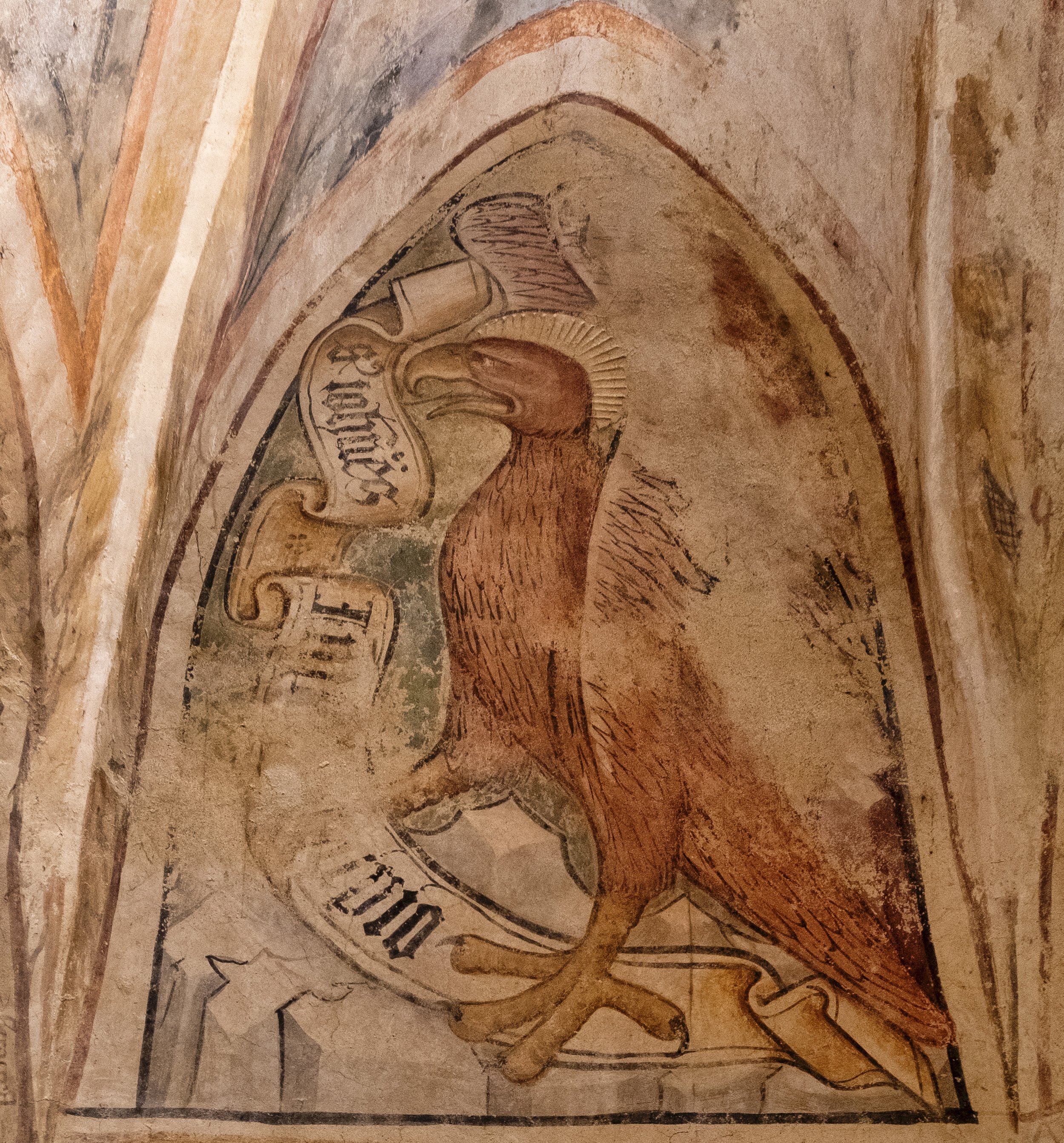
The frescos have worn over the centuries, but among the surviving fragments of the sanctuary the symbols of the four gospels are easily found - the lion representing Mark, the eagle John, the angel Matthew, and the oxen Luke. On the sanctuary's north wall, a self-portrait of Aquila himself can even be made out. The window recess of the sanctuary is decorated with floral and herbal motifs.

Above is a depiction of the Veil of Veronica with the likeness of Christ. The threefold circle in the pinnacle of the sanctuary side of the triumphal arch symbolises the Holy Trinity. The image of Christ the Judge is outside the central piece, while the images to the right and left symbolise good and evil deeds. Below and to one side, a cavalry scene can be made out, and St Anne with Mary and the child Jesus can be seen on the opposite side.

The church dedicated to the Holy Trinity (Szentháromság) and to King St Stephen (Szent István király) is located towards the southeast edge of town, away from the main road.

A Soaring Symbol: The Eagle in Aquila's Frescoes

One cannot discuss Aquila's work without noting the compelling presence of the eagle. In many cultures and religious traditions, the eagle symbolises strength, renewal, and spiritual ascension. Its inclusion in Aquila's frescoes could serve multiple symbolic purposes:

  1. Divine Connection: The eagle, with its ability to soar towards the heavens, is often seen as a messenger or intermediary between the divine and the earthly realm. Its presence in the frescoes may signify the spiritual journey from the mortal world to the divine, echoing the Christian belief in resurrection and eternal life.

  2. Personal Emblem: Given that 'Aquila' translates to 'eagle' in Latin, the artist's use of this symbol could also be a personal signature, a way of marking his work with a visual emblem that is both deeply meaningful and reflective of his own name. This interplay between the artist's identity and the symbolic imagery enriches the narrative woven into the frescoes.

  3. Guardianship and Vigilance: In Christian iconography, the eagle is also associated with St. John the Evangelist, symbolizing clarity of vision and spiritual insight. Its inclusion might suggest a thematic focus on the Gospels' messages and a call to vigilance in faith.

Deciphering the Frescoes: Layers of Meaning

Like the eagle within the Velemer church, the frescoes invite viewers to explore layers of meaning woven together with theological themes and personal stories. These artworks are more than mere decorations; they are visual sermons, teaching and inspiring those who gaze upon them.

Janos Aquila's mastery lies in blending traditional Christian iconography with local cultural motifs, creating a tapestry that speaks universally and specifically to the community for whom it was made. The frescoes serve as a bridge, connecting the earthly to the divine, the individual to the community, and the past to the present.

Reflecting on the Past, Inspiring the Future

For photographers and art enthusiasts, the frescoes offer a unique study in the power of visual storytelling. Through his use of colour, composition, and symbolism, Aquila invites us into a reflective dialogue with our spiritual and artistic journeys.

Exploring the frescoes of the Velemer church is not just an academic exercise; it's a pilgrimage into the heart of human creativity and divine inspiration. Janos Aquila's work challenges us to look beyond the surface, to find meaning in the symbols that surround us, and to appreciate the profound connection between art, faith, and life.

My post about Martjanci church is here

#Ancient_monument #Hungary #műemlék #Temple #templom

Reformed Church of Szentgyörgyvölgy

Among the Reformed churches with painted coffered ceilings in Hungary, the church of Szentgyörgyvölgy.

The Reformed people of Szentgyörgyvölgy temporarily built a mud-walled house of worship as early as 1762, then II. Taking advantage of Joseph's leniency decree, the construction of a brick church was also planned.

This - then without a tower - was erected in 1787 in such a hurry that the carpenters were said to have carved the beams from the logs brought from the forest on the cart so that by the time the permit was revoked, they would be ready for everything.

DJI_0528.jpg


Its tower was erected in 1792-93, until then a small wooden belfry stood next to the building. The church bears the marks of folk baroque style.

The walls and the tower consumed the money of the ecclesia, and it took many years for the materials needed for the interior furnishings and ceilings to be collected. Moreover, in 1805 - to this day it is not known why; probably due to the hasty foundation - the church wall was cracked, the beam holding the choir was broken. Due to lack of funds, the repair took until 1820.


On the south side of the interior of the church rises the crowned pulpit, on the other sides a porch resting on wooden pillars was built. The ceiling was assembled from 88 wooden cassettes.

The rectangular boards are decorated with lamb cloud motifs in the sky. The porch was built on three sides; its parapet consists of 20 cassettes with folk carved slats at the edges. The bottom of the galleries is also cassette-shaped (37 cassettes).

At the bottom of the galleries, we can see blue, white, black floral and star ornaments reminiscent of embroidery patterns (these are less worn and faded than the colours of the parapet and ceiling). Some panels on the parapet are carved, others are adorned with painted geometric patterns. The painting of the wooden columns mimics the pattern of the columns laid out of stone.

The gallery can be reached by a wooden staircase at its eastern and western ends. In the centre of the ceiling, on two panels, is a motif different from the other cassettes: around the flower symbolizing the Sun, the inscription: “This place is none other than the house of God, and the gate of Heaven. (Genesis 28:17). How loving are thy tabernacles, O Lord of hosts. Sat LXXXIV Sold 25 v. ”

The central big star, the biblical quotations are written around it, and the subsequent beaded decoration is surrounded by a wreath of pearl flowers. Ribbon drifts on the wreath.

The inscription on the visible sections of the tape reads: “In 1829, Officer. Scientist István Hajas painted András Patkó in his Preaching ”. At the tower end of the ceiling, in one of the cassettes on the south corner, is the name of the carpenters. Above the two exits, another large star can be seen.

The pulpit contrasts with the simple interior image with its dark brown colour and baroque shape. It consists of two parts: the actual pulpit and the crown are both carved and painted. The lower edge of the crown was sawn out of plank; it hangs bell-like ornaments.

Zois Palace and Križevniška in Ljubljana

A friend of mine and a great photographer Blaž Gutman recently showed me an interesting image of the area dating back late 1700! This woke up in me the desire to find more informations.


ZOIS PALACE

The Zois Palace in Ljubljana was built in the second half of the 18th century with the merging and partial rebuilding of older houses on the Breg between today's Križevniška Ulica and Zoisova cesta. 

IMG_20200808_094119.jpg

Baron Michelangelo Zois (1694-1777), the father of Žiga Zois (1747-1819), bought a house on the Breg on the corner of Nemška (today Križevniška) Street in 1728, which became the first home of the Zois in Ljubljana. In the early 1960s, he bought three smaller houses on the then Nemška Street, and in 1765 Erberg's house on Breg - a large building that was in the 16th century. built as a city warehouse. Next to Erberg's house, on the corner, along the city wall, stood the house of the abbot of Bistrica - the so-called "Bistrica court", which together with the church of St. Lawrence and part of the defensive walls were bought by Žiga Zois in 1793.

He had the church and the wall demolished to gain space for a garden, he annexed the house of the abbots of Bistrica to his estate and by 1798 had united all three buildings with a single façade. The facade is designed in the spirit of classicism, strict and somewhat monotonous, without any special architectural decoration. On the ground floor and on the first floor were rooms for trade and storage of goods, on the second floor had Baron Žiga Zois his living quarters and the famous cabinet with a rich library with about 4000 books and a famous collection of minerals in which was ok. 5000 exhibits. 

An old drawing can be seen here http://www.dedi.si/dediscina/335-zoisova-palaca-v-ljubljani

An old drawing can be seen here http://www.dedi.si/dediscina/335-zoisova-palaca-v-ljubljani

Renovation of the facade in 1938 spoiled the visual image of the original facade, as due to the thick layer of new plaster, the window frames are sunk into the wall and therefore less pronounced. The main decoration of the stone ground floor is a monumental portal made for the city warehouse building by Abondio Donino in 1589, but it was in the 18th century. processed. The key of the original portal with the city coat of arms is today built to the left of the main entrance. To the right of the front door is a bronze portrait bust of Žiga Zois, made by Mirsad Begić. In the courtyard of the palace is a built-in tombstone of Baron Žiga Zois, brought from the abandoned Ljubljana cemetery near the church of St. Christopher. Zois Palace is today a multi-apartment house with private apartments and smaller shops on the ground floor. The palace is ok. in 1780 it became one of the most important social centres, where Slovene intellectuals and artists who worked in the spirit of the Enlightenment gathered. The so-called Zois circle was formed, which included Anton Tomaž Linhart, Valentin Vodnik, Jurij Japelj, Jernej Kopitar, Blaž Kumerdej and others. As a widely educated patron and member of the Enlightenment, Žiga Zois was one of the most prominent co-creators of intellectual life in Carniola in the late 18th and early 19th centuries. Although he also engaged in literary work and translated foreign literary works into Slovene, he is mainly credited as the initiator and supporter of Slovene literary design and linguistic activity. Even after 1797, when he no longer walked out of the house due to paralysis (he moved around the apartment in a wheelchair, which he constructed himself), he remained socially active and active in various fields of science from mineralogy, metallurgy and geology to zoology and botany. . Just before his death, in severe financial distress, he sold the palace with a library and a collection of minerals to his nephew Karl, but he wanted them to continue serving Slovenian science in the future.


Templars

Križevniška ulica, which used to be known as Ribiška, is one of the oldest streets in Ljubljana. Between 1167 and 1200 the Knights Templar had a stronghold here, later superseded by the Teutonic Order. The Spanheim noble family, who set up the administrative centre of their estates in Carniola in Ljubljana in the 12th century, founded the monastic church of Mary, Help of Christians here, and alongside it a monastic house with a hospital and school for the education of poor children.

The Knights Templar were a famous Christian military order of the Middle Ages. Although they’re gone (except in the occasional mystery novel) their buildings are still around. In Slovenia, their legacy remains in the old Monastery Church and the area known as Križanke. The name is the first clue. However, even though Križanke means crossword puzzle in Slovene, the name owes its origins to the word Križar, which is crusader. The crusading knights, in fact, put up a post there back in 1167 and ran it for about 50 years, until the Teutonic Knights took it over.

Screenshot 2020-08-08 at 15.27.54.png
Booking.com


Güssing Castle in Austria

The castle was first documented in 1157 and was built on an extinct volcano. The castle in Güssing is the oldest in Burgenland. After several changing hands of ownership, the castle finally came into the possession of the Hungarian magnate Batthyány family, which has shaped the castle and city substantially.

burg-gussing-645238_1920.jpg


A trip to the castle is an absolute must to anyone visiting Güssing. A walk through the castle museum is worthwhile and to finish off in the castle wine cellar restaurant which offers a spectacular view of the whole area around Güssing. Another major attraction of Güssing is the Franciscan monastery. In recent years it has become the destination for many pilgrims, especially from Hungary, because the church is the shrine of the Blessed Ladislaus Batthyány-Strattmann.

After a day full of learning about history and admiring the castle walls, head across the Austrian border to Mjus World for some first-class pampering in their spa.

IMG_20200718_164558 copy2.jpg

Castle Grad in Prekmurje - Slovenia

Castle Grad is located in the stunning Natural Park Goričko in village Grad. The castle stands on a steep hill of basaltic tuff above the Grad settlement.

According to old tales, the Knights Templar began its construction. Over the course of eight centuries, a large pentagonal castle structure was build, which is today considered one of the largest baroque castles in Slovenia.

Following attacks by the Turks, peasants and rebellious farmers, the castle got its baroque image with multi-level arcade corridors, a castle chapel and a bell tower. Elements of other periods, from Romanesque, are skillfully included in the castle complex and reflect the wealth if its owners. 

Castle Grad

Castle Grad

The exterior around the castle was once magnificent; an English garden with trees and plants from different parts of the world. The interior of the Castle Grad and the huge inner courtyard were once the pride and joy of its noble residents.


Some effort has been put towards reviving the mighty castle into its old glory, but the job is far from done. Some of the smaller rooms have been arranged into museum rooms and are dedicated to pottery, herbalist and other crafts.

The wine cellar is open for wine tastings. Three rooms in the Castle Grad have been transformed into luxury hotel rooms and the bravest guests can spend a night or two in a prestige castle.

The inner courtyard is now arranged into a nice terrace – perfect for a snack break or cup of coffee. Special events are also organized here and healing Energy Spots have been located at some points around the courtyard of Castle Grad.

The partly renovated castle might not seem like a perfect trip, but Castle Grad is really something special. I do not know if it is the healing energy or just an imagination, but you will have a hard time leaving this castle once you see it.

You will want to explore the rooms of the castle, searching for knights and beautiful princesses. The views over the amazing nature of Goričko and the resting atmosphere will fill you up with energy and you will start wondering just how amazing it would be to stay in this castle.

Confused about your Portfolio?!?!?

Some of the most frequent questions I get from photographers are how to organize the portfolio and what work to include and how many images,

Deciding what work to showcase can be a challenge, so here are some tips to get you started: 

  1. Choose just ten images that you know will make you stand out. In the future feel free to create more galleries but for now just select ten of your best pieces.

  2. Think of this as your highlight reel. This is your chance to make a great first impression.

  3. If you can, try looking at your work through the eyes of a prospective client, employer, or photo editor. What jumps out at you? It can also be helpful to select pieces you’ve received praise for in the past. 

  4. Try to distance yourself from your work, criticise it, and do not be self-opinionated and just believe you are the best!

  5. Still not sure what to include? Ask for a second opinion! Enlist a trusted friend or colleague and get their honest feedback.

If you would like to schedule a Portfolio review check here

My Favourite Fujifilm JPEG Settings

One of the reasons I fell in love with the Fujifilm X-Series was because of the great jpeg processing software that was placed into every camera. I shoot with an XT-3, I am afraid I do not like the latest XT, and I prefer shooting instead with my Leiucas or Sony!

I tend to shoot nowadays mainly in jpg,m I know many people only shoot RAW, and that is absolutely fine of course.  This article will hopefully help the ones of you that do shoot JPG or that want a starting point for JPG settings of your own.


Fujifilm JPG Settings

To create your own JPEG settings, go to Edit/Save Custom Setting in the IQ section of the menu.  From here you can save up to seven different settings.  To make it even easier to switch between settings, you can change one of the FN5 buttons to ‘Select Custom Setting.’  In this way, you can quickly and very easily change presets.

I like to title my Custom Settings with names that I will recognise fairly quickly. 


Colour Fujifilm JPEG Settings


Velvia Landscape

For landscapes, if I like a punch picture I often use Velvia which really brings out the colour in every scene. Velvia is one of my fav Film!

  • Dynamic Range: 100

  • Film Simulation: Velvia

  • Grain: Off

  • WB: Auto +1 Red

  • Highlight: -1

  • Shadow: +3

  • Colour: +3

  • Sharpness: +2

  • Noise Reduction: -1

_DSF9252.jpg


Astia Countryside

One of my favourites right now it is the one I use most of the time living in the countryside

  • Dynamic Range: 100

  • Film Simulation: Astia

  • Grain Off

  • White Balance (WB) Auto +1 Red

  • Highlight -1

  • Shadow +2

  • Color +1

  • Sharpness -1

  • Noise Reduction: -2

DSCF1631 copy.jpg


A day in the City

The Classic Chrome. This is the one that I switch to for street photography. 

  • Dynamic Range: 100

  • Film Simulation: Classic Chrome

  • Grain: Off

  • WB: Auto +1 Red

  • Highlight: 0

  • Shadow: +2

  • Colour: +3

  • Sharpness: +3

  • Noise Reduction: -2

DSCF2533.jpg


Portraits Pro

My favourite for portraits with muted tones and super gentle on skin

  • Dynamic Range: 100

  • Film Simulation: Pro Neg High

  • Grain: Weak

  • Highlights: -1

  • Shadows: +1

  • Colour: -2

  • Sharpness: +1

  • Noise Reduction: -2

3DS_5818 copy.jpg


Monochrome Fujifilm JPEG Settings

Acros I

I simply love Black and White I shot as well with a Leica Monochrom and this is the setting I like

  • Dynamic Range: 100

  • Film Simulation: Acros Red

  • Grain: Off

  • WB: Auto +1 Red

  • Highlight: -1

  • Shadow: +3

  • Sharpness: +1

  • Noise Reduction: -1

3DS_3372 copy.jpg


Acros II

Another black and white setting with Acros a bit more gentle and subtle

  • Dynamic Range: 200

  • Film Simulation: Acros

  • Grain: Off

  • WB: Auto +1 Red

  • Highlight: +2

  • Shadow: +2

  • Sharpness: +2

  • Noise Reduction: -2

Canaletto Views -08 copy.jpg

Portrait

It’s a little softer, less aggressive and because it uses the Green filter on Acros it’s more pleasing for portraits on the skin tones .

  • Dynamic Range: Auto

  • Film Simulation: Acros + G

  • Grain: Off

  • Highlights: -1

  • Shadows: +2

  • Sharpness: +1

  • Noise Reduction: -1

arti2.jpg


Berengo Gardin

This is probably my favourite custom setting at the moment.

I’ve called it Berengo Gardin to honour the great Italian photojournalist Gianni Berengo Gardin

L1000947 copy.jpg
  • Dynamic Range: 100

  • Film Simulation: Monochrome + R

  • Grain: Strong

  • Highlights: 0

  • Shadows: +2

  • Sharpness: +1

  • Noise Reduction: 0


Post Processing

I mainly use Photoshop but my favourite piece of Software is produced by Skylum and is Luminar Neo.

It has a powerful engine for higher performance and flexibility. It also packs exciting and innovative tools that let you fulfil your vision.

Channel your creativity with the infinite possibilities of the new Layers feature. Relight an image that lacks lighting sources based on image depth.

Where To Stay in Ljubljana

Ljubljana is one of the smallest capitals in the world, which makes it easy to move in between its neighbourhoods. The borders between the areas are not strictly defined, though are well known to the residents.

The city center is the most vibrant part of the city, and the outskirts are more suitable for those who wish to be closer to nature. Next time you visit, make sure you stop by these top five neighbourhoods in Ljubljana.

Antiq Palace

Screenshot 2020-02-11 at 14.28.01.png

Housed in a former aristocratic residence, this family-friendly boutique hotel is situated in a tranquil spot in the heart of Ljubljana. Member of the Small Luxury Hotels of the World. The rooms and suites combine 16th-century details with the latest technologies. Some rooms feature flat-screen TVs with satellite channels, minibars and private spa baths. Guests can make use of free Wi-Fi connection while seating comfortably in the velvet armchairs.

The Antiq Palace - Small Luxury Hotels Of The World features 2 open courtyards with wrought iron furniture and an open fire where guests can relax. To enjoy a contemporary drink in classic surroundings, the hotel has 2 lounge bars. Guests of the Antiq Palace benefit from a complimentary drink upon arrival and access to the Executive Business centre.

CLICK HERE


Apartments Hiša Pod Gradom

Screenshot 2020-02-11 at 14.25.10.png

Set in Ljubljana, 1.4 km from Ljubljana Castle and 200 m from Ljubljana Central Market, Apartments Hiša Pod Gradom offers accommodation with free WiFi, air conditioning, a restaurant and a bar. Private parking is available on site.

Each unit is fitted with a fully equipped kitchen with a dishwasher, a seating area with a sofa, a flat-screen TV, a washing machine, and a private bathroom with shower and a hairdryer. A fridge, an oven and stovetop are also offered, as well as a kettle.

Guests at the apartment can enjoy a buffet breakfast.

A terrace is available for guests to use at Apartments Hiša Pod Gradom.

Ljubljana Puppet Theatre is 300 m from the accommodation, while Metelkova Mesto is 1.3 km from the property. The nearest airport is Ljubljana Jože Pučnik, 26 km from Apartments Hiša Pod Gradom, and the property offers a paid airport shuttle service.

This is our guests' favourite part of Ljubljana, according to independent reviews.

CLICK HERE

Adora Hotel

Screenshot 2020-02-11 at 14.23.59.png

Offering bright rooms, an on-site bar, bike rental and free Wi-Fi, Adora Hotel is a family-run boutique hotel set in Ljubljana’s Old Town, just beneath Ljubljana Castle and only steps away from the picturesque banks of Ljubljanica River filled with restaurants and bars. Housed in a traditional building, all rooms come with hardwood floors and wooden furnishings and are accessible by elevator.

They offer either a view of Ljubljana Castle or of the Old Town. Amenities include an LCD satellite TV, a safe and air conditioning. Guests can enjoy their breakfast in the back garden with a terrace and a lawn with deck chairs, or relax at the Adora Hotel's private bar serving a variety of Slovenia's finest wines. The hotel has a 24-hour reception desk and offers bikes free of charge. A reception hall with an international selection of books, local board games and a free internet corner is at guests’ disposal. The nearest grocery store can be reached within 100 metres.

The Main Bus and Train Station is 2 km from the Adora Hotel. Ljubljana Airport is at a distance of 20 km.

CLICK HERE


Grand Hotel Union

Located just steps away from the central Prešern Square and Tromostovje in Ljubljana, Grand Hotel Union offers accommodation in a historical Art Nouveau building. Free WiFi access is provided in all areas.

All spacious and tastefully decorated air-conditioned rooms come with a flat-screen cable TV, a minibar and a safe, while private bathrooms feature a bathtub, free toiletries and a hairdryer. Slippers and bathrobes are provided for your comfort. Some units also come with a seating area. All guests are welcome to enjoy the complimentary buffet breakfast.

Grand Hotel Union is famous for its' Grand Union Café where guests can relax with a cup of coffee or tea accompanied by a varied offer of cakes and pastries in a historic setting. Restaurant and bar Atelje combines international and Slovene cuisine in an intimate and welcoming setting, while the Restaurant Union provides a unique dining experience in the private garden of Grand Hotel Union. The hotel also features a wine library with a selection of Slovene wines and a casual lobby bar.

The wellness centre is on the top level of Grand Hotel Union Business and features a swimming pool with views of Ljubljana Castle and saunas that can all be used free of charge. The hotel also has a 24-hour fitness centre and a shopping gallery with a fashion boutique, a jewellery shop, a souvenir shop, a barber and a hairstylist. The congress centre features 21 fully equipped multifunctional halls that cater to all types of events.

Ljubljana Old Town can be reached in 180 metres, while the Ljubljanica River Promenade is just 100 m away. Ljubljana Castle is 1 km away, while the Ljubljana Cathedral is at a distance of 500 m. Cankarjev dom can be reached in 900 metres, while Ljubljana Fair is 1 km away.

The Main Bus and Railway Station are 700 m away. Ljubljana Airport can be reached in 25 km. Paid covered parking is provided on-site and airport transfers can be arranged upon request and at a surcharge.

CLICK HERE

Screenshot 2020-02-11 at 14.38.02.png


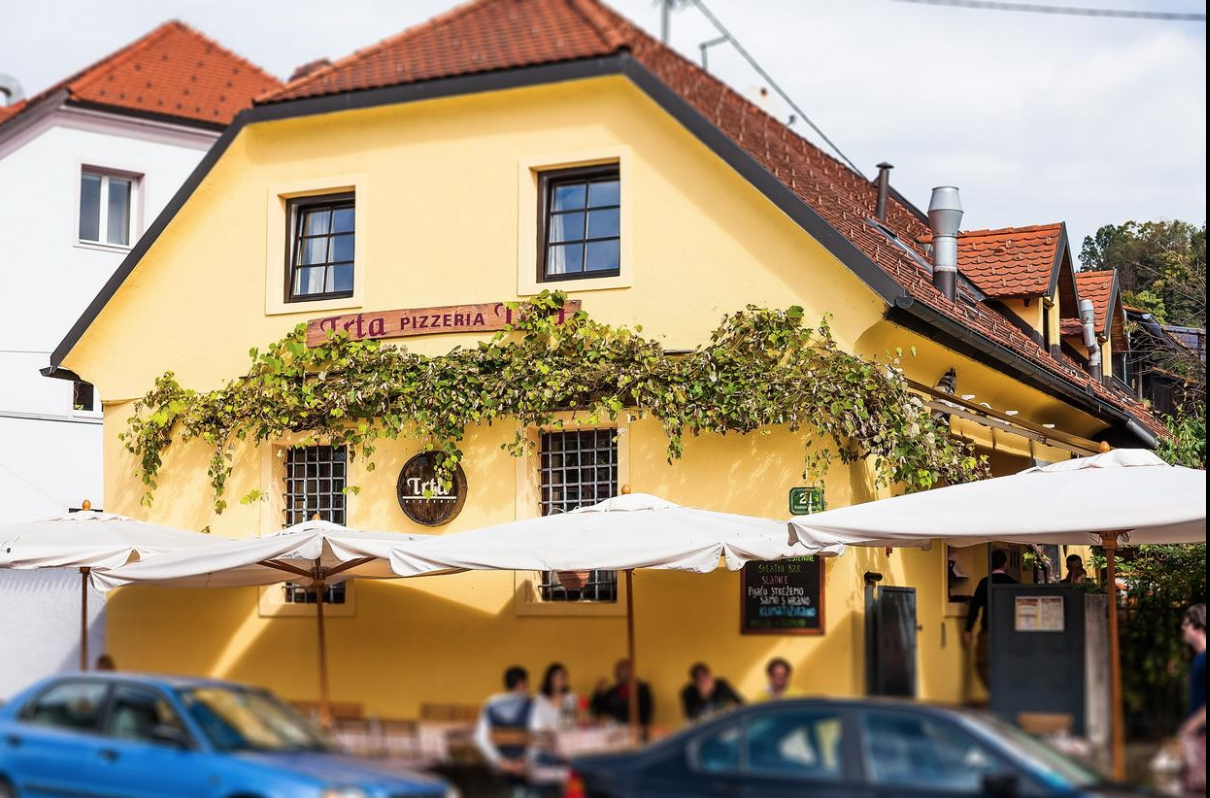
House Trta

Situated along the bank of Ljubljanica River, Guest House Trta offers an on-site restaurant. Guests enjoy free WiFi, and a flat-screen TV with cable channels in their room. The guest house is located just 600 m from Ljubljana Castle and a 5-minute drive from Tivoli Park. Brnik Airport is a 30-minute drive away. These air-conditioned rooms offer a refrigerator. There is a private bathroom with a shower and free toiletries. Some rooms also offer a fully equipped kitchen and river views. Towels and linen are provided.

CLICK HERE


Booking.com

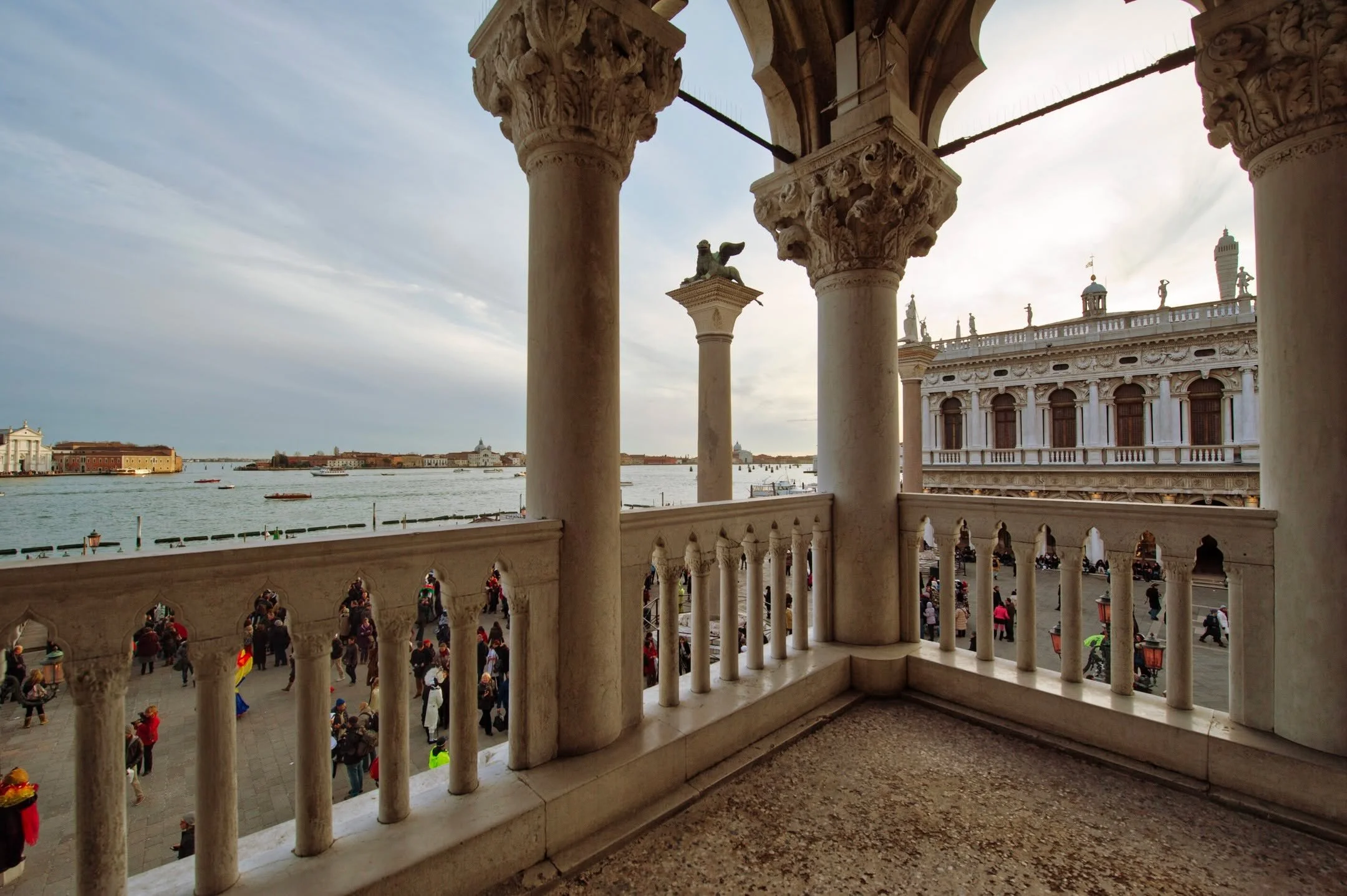
Top Photography And Instagram Spots In And Around Venice

Venice is not less than a beautiful maze lined with historic architecture. Venice is one of the most beautiful cities for photography and photo walk and walking tours that I have come across. In fact, when I was there, I could not keep my camera off.

If you are planning anytime soon to pay a visit to Venice, here are some stunning photography spots in Venice. Keep moving forward to know the secret spots for Instagram-worthy photos.

daniel-corneschi-MCa9QFiWvMw-unsplash.jpg

Rialto Bridge 

A great bridge for a walking tour along with a beautiful sight of the sunset. Here, not only can you take amazing photos of the sunset but stunning the Great Grand Canal photos with historic architecture buildings on either side. You can visit it almost anytime. However, I would suggest going to the bridge at night for witnessing the horizon over well-lit buildings.

Piazza San Marco 

It is one of the most popular tourist destinations in Venice. It is also known as Saint Mark’s Square as it is similar to a huge square with Campanile on one end and Saint Mark’s Basilica on the other end. Fortunately, if there is High Water, the square may become a bit flooded and you could get the chance to capture amazing photos with reflections. Reflections in Photos can enhance your picture composition.

Bridge of Sighs

For the best view of Bridge of Sighs, head over to Ponte Della Paglia that is just along Riva Degli Schiavoni. If you are on a Photo Walk, I recommend going there in the day time so that you can get a better shot.

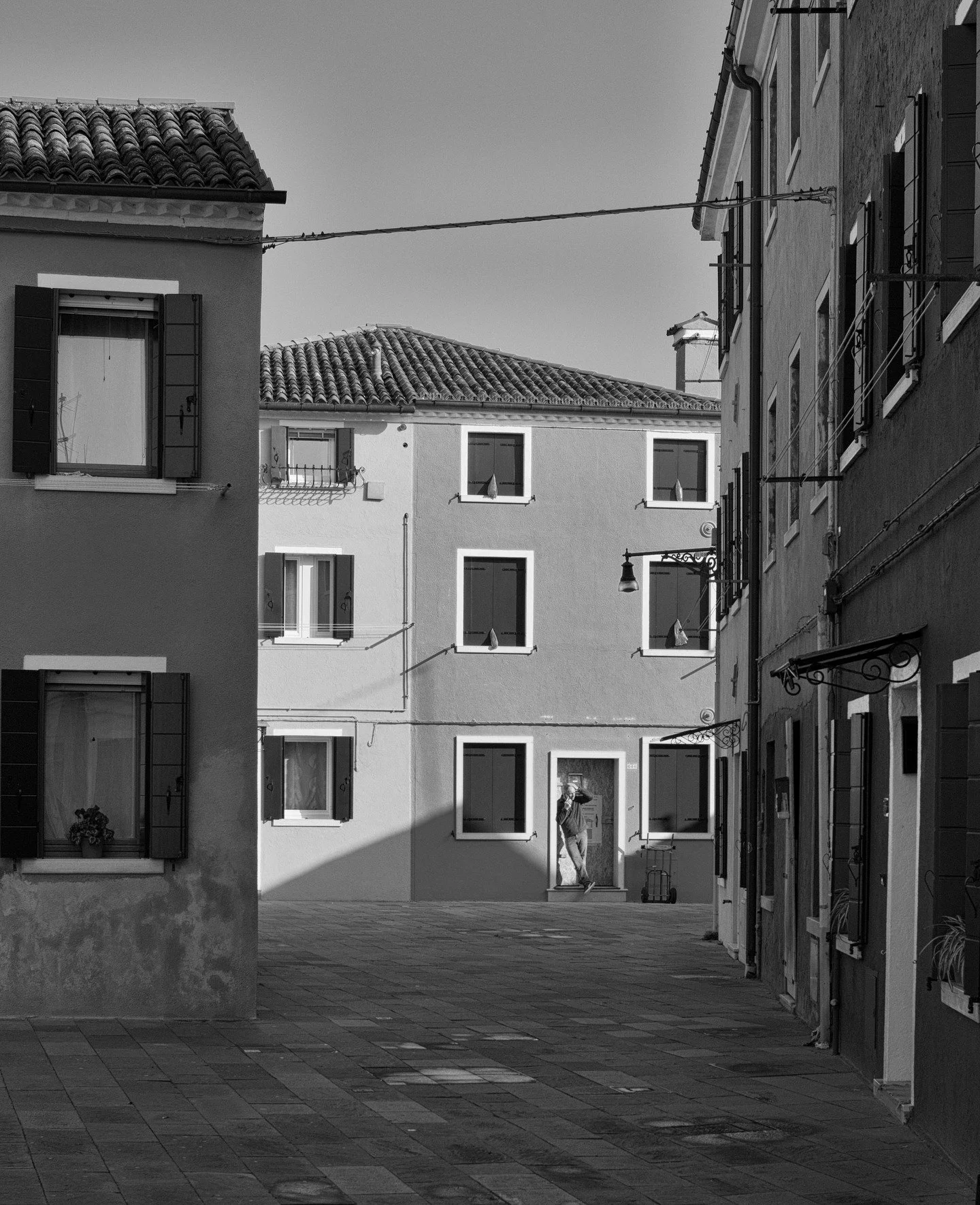
Burano

Burano is one of my favourite places in Venice because of its vibrancy. Its actually 30-40 minutes away from Venice you can use public transport or you may take a taxi boat.

The place is photogenic. Hence, best for photography. It’s a key sport for photography. I recommend going there in the afternoon. The colours you would see at Burano are exceptional and do justice to the buildings.

Fondamenta Cannaregio 

If you are on a walking tour, there is no way you would miss the pedestrian bridges of Fondamenta Cannaregio. You can do photography from both the bridges that run over the canal. It costs absolutely nothing to go there. Moreover, you could go at any time you like. Just make sure to click amazing pictures!

Ponte De I’Academia

This bridge is the second most popular bridge after Rialto for Photography. It gives you great views of canals that follow towards Santa Maria Della Church. If you happen to visit it at night time, make sure to capture photos with long exposure so that you could get boats’ light trails.

Murano

Murano is just 5min from Venice. You can go there by waterbus, the place is famous for its glass art. At this tourist destination, you would find several nice spots for photography along with bridges and canals. It’s not the same as Venice so, the camera eye would witness something different!

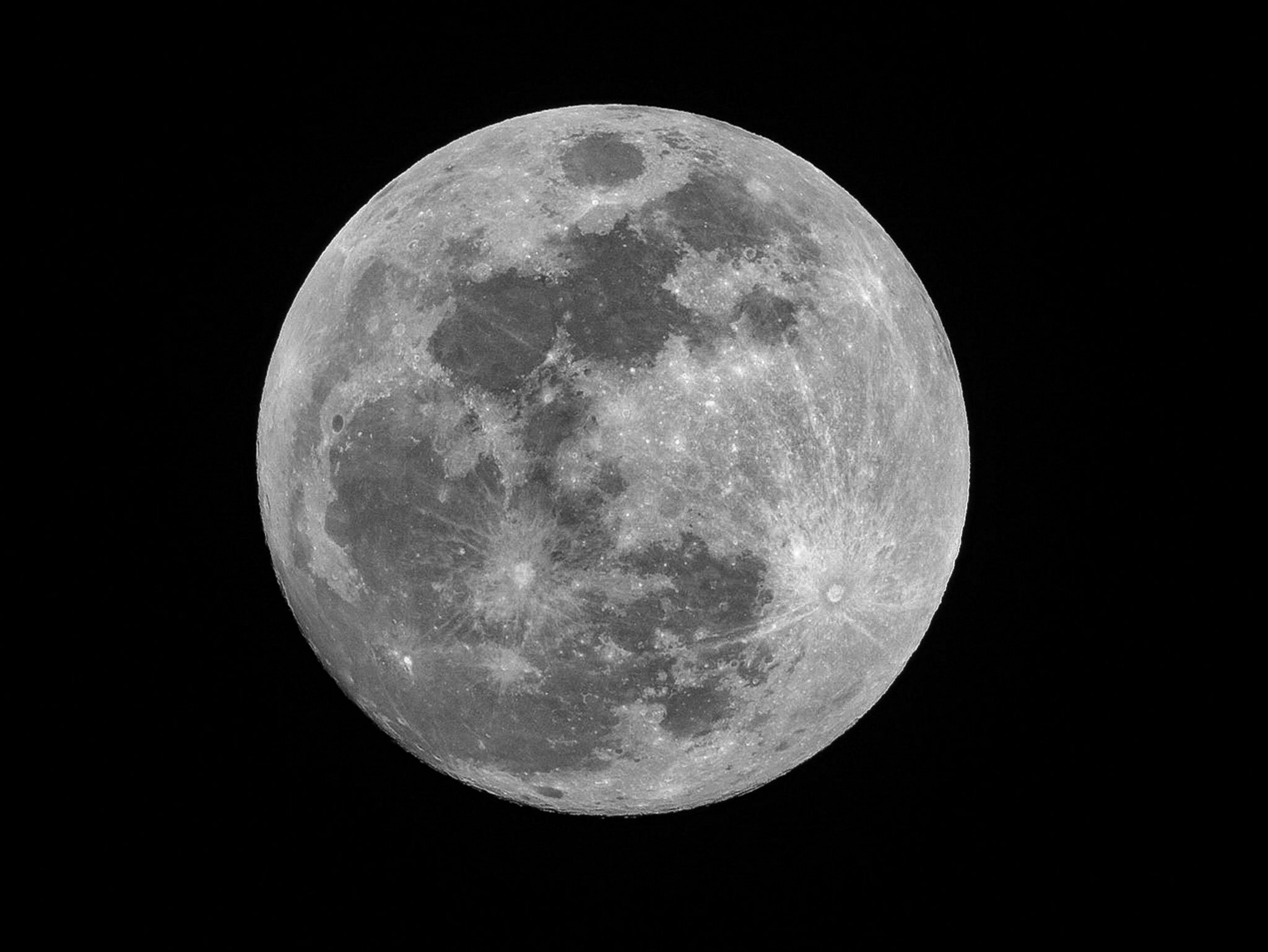
Full Moon. How-to

Another full moon event is right around the corner and you don't want to miss it.

A Snow Moon, of the second full moon of winter, will appear from Friday evening to Monday morning.

Before you head outside with your camera to capture that Instagram worthy image, here are some tips and tricks from an avid space photographer.


The equipment

OK, let's get down to business. First, you need the right equipment.

I use what is known as "micro four-thirds" cameras, as they are smaller, lighter and cheaper than the standard interchangeable cameras,

The reason I enjoy the smaller, lighter camera is because it's easier to move around, especially with all your gear. I also suggest having a number of different lenses, from extreme wide-angle to 400mm. The latter is in relative resolution, equals to 700mm telephoto lens on a regular camera.


Location, location, location

I suggest downloading a moon locator app on your phone.

Many of them can superimpose this information on a real-time camera image on our phones, We point the (cellphone) camera toward the horizon and the app will show us where the moon (or sun) will rise, its trajectory through the sky, where it will set and the times of these events.

This will help you to find the perfect location to set up your tripod.


The camera settings

Now on to those pesky camera settings, that "auto" setting is not your friend when taking images of the moon because the moon reflects a bunch of light from the sun.

If a camera is set to "AUTO" setting, it will "see" all of the darkness (black) of space and try to make it exposed to halfway between black and white -- therefore, increasing the exposure (by a lot!),

When using a lens with a focal length (or equivalent) of 600mm or longer:
ISO: 800
Aperture: 6.7 (or close)
Shutter speed: (somewhere between) 1/1250 -1/2500 second

But wait, there's more!
Shutter speeds hand-held shots are doable but I highly recommends a tripod. I even suggest a remote shutter release to ensure the elimination of almost all camera shake.

Editing

Now that you have your images, I suggest editing them to black and white. Here's why:

As the lunar soil (regolith) is a light, greyish-brown colour, it is not very photogenic, and it doesn't show much contrast between brightly lit areas and shadows. This then helps to tweak the contrast and brightness if needed.


Can I Get Verified?!?!

All my main Social Media Accounts Facebook, Twitter and Instagram have the “Verified” badge and I am often asked if is important and how to get it. So I decided to compile a brief post!

verification.jpg

In a world of fake news and widespread media distrust, social media verification will be more important in 2020 than ever so getting verified on social media is one of the ways brands build trust with their customers.

Whether it’s your personal account, your business account getting that little “checkmark” next to the profile name is massively important. In fact, it provides instant social proof and credibility when anyone looks up you or your company online.

Verification can also help with networking or to push your company toward the forefront of your industry as a trusted option.

Getting verified can be pretty difficult to do, and it might take some time, but it is definitely possible. And it’s worth it.

But maybe you’ve already tried to become verified and you were rejected. Or perhaps you just don’t know where to start.

Unless you’ve got a huge following like Beyonce, becoming a verified account takes some commitment and trial and error.

It began as a way for the platform to identify which Twitter accounts belonged to celebrities.

But now, it’s evolved into a way to verify which accounts belong to brands, companies, and influencers as well.

Basically, it serves as an instant way to tell other users, “Hey, this account isn’t just your average Joe — pay attention to it!”

GENERAL SUGGESTION

To verify your personal account to become an influencer in your industry, begin by making sure that your  Social Media is updated

Add a recent profile picture and make sure your profile information is all filled out.

If you haven’t been posting regularly you’ll need to wait until you’ve regularly posted for a consistent amount of time before trying to verify it.

Post original and interesting contents on a regular basis

Build your following and post engaging images.

Add as much identity-supporting information as possible to your profile to make it appear, official, even though there’s no checkmark.

Bes sure you have a verified phone number and a confirmed email address

Do not forget is also important to have a bio, a profile photo a header photo and website

Your Posts must be set to Public

Have your ID ready you will need to send a copy to them

TWITTER

Twitter was the first social network to start issuing verifications. Verified accounts show a small blue checkmark next to their name, and the process for becoming verified is pretty easy: just make sure your account is completely filled out and send over examples of your web properties.

But I have some disappointing news for you. 

Twitter has paused all new account verifications 😢

Yeah, you read that right, the micro-blogging network decided to pause verifications for new accounts while it worked on a new verification program.

Since then, no further details have been released, so we'll have to sit tight and hope that 2020 brings the advent of a new Twitter verification program.

I'll keep you updated.

INSTAGRAM

It is extremely difficult to get verified on Instagram because the company focuses on verifying accounts that have a high probability of being impersonated and does not take requests. However, it is not impossible.

Because Instagram’s focus is on preventing impersonation, amassing a huge number of followers is not guaranteed to earn an account a blue checkmark.

Instagram suggests that those after verification prove their account is real in other ways, such as linking to an official website or a verified account on Facebook or Twitter. This is not a foolproof method but can help you position your brand as one that could be at risk of impersonation.

FACEBOOK

Facebook is the largest (and arguably most important) social networks for business. So naturally, it has a relatively straightforward verification process.

There are two types of Facebook verification: blue badges and grey badges.

Blue badges are only for the following categories of people:

  • Journalists

  • Popular Brand or Businesses

  • Government Officials

  • Celebrities

  • Media

  • Entertainment

  • Sports Companies

If you have a compelling reason to be verified, high-quality content, and a large amount of press surrounding your brand, you can submit for verification. 

Once you're verified, your brand will have a small blue checkbox next to its name. Unfortunately, however, this doesn't carry over to its sister social network, Instagram.

To get verified, just do this:

  1. Make sure your cover photo, logo, and profile info are completely up-to-date

  2. Fill out this form and wait for a response from Facebook

Gray badges are only for business pages and were introduced in 2015 as a way for businesses to confirm they’re authentic. The approval process is much shorter (about 48 hours) and the requirements are a lot less stringent.

Note: Facebook is phasing out grey badges “based on user feedback,” so you can no longer apply for it. Instead, Facebook encourages businesses to authenticate their profiles by linking to them on official websites, updating profile imagery, and making sure contact information is accurate.

GOOGLE MY BUSINESS

Getting verified on Google My Business is super important.

Once verified, your users will see a blue shield with a checkmark in it on your listing in Search and Maps. This is important because users will have no doubts that your hours, address, and other important info is up-to-date.

This will make them more likely to swing by and check out your establishment.

To verify your account, do the following:

  1. Sign in to Google My Business and choose the business you'd like to verify

  2. Click Verify now and follow the on-screen prompts to request your verification postcard

  3. Once the card arrives, log back in and punch in the verification code on the postcard, and you're verified!

Budapest Camera Stores

Hungary’s photography history is full of prodigious visual artists as André Kertész, László Moholy-Nagy, Robert Capa, and Brassai – all of whom are immortalized in Budapest museums such as the Capa Center and the Mai Manó House, where various exhibitions and books popularize historic and fresh photography to this day. Budapest is also a stunning city with countless marvels, sights, faces, and places to capture.

Anyone with artistic or photojournalistic aspirations can find a gadget to their liking in the various camera stores found around downtown – whether they are old-fashioned film fanatics or digital devotees – along with photo-printing businesses offering everything from oversized high-definition prints to passport snapshots.

History-of-Black-and-White-Vintage-Photography.jpg


These are my fav. shops in Budapest:


OPTICAM

IMG_20200131_112328 copy.jpg


This small shop in Bajcsy-Zsilinszky Street is not at all obvious at first glance, but stepping in, customers find themselves facing a small but impressive collection of mostly secondhand cameras, but occasionally a few brand-new pieces are mixed in. They have different cameras, lenses, cases, film, and flashes as well, all part of a vast assortment that turns over regularly, as, despite the small size of the shop, there are still a great number of customers due to the central location. The staff is helpful, and they also take repair orders to bring broken cameras back to life.

Address: Budapest 1051, Bajcsy-Zsilinkszky út 20
Facebook
More information on their website.

F8

IMG_20200131_112705 copy.jpg

Cool interior full of vintage cameras. Helpful and knowledgeable staff. They can develop and scan negatives for you professionally.
It's a dog-friendly place, which is also a plus. I can recommend them wholeheartedly.


Ó u. 9 (210.19 km) 1066 Budapest, Hungary

Facebook

CAFÉ ANALÓG - LOMOGRAPHY

IMG_20200131_114353 copy.jpg

The Budapest Embassy of Lomography, Café Analóg is a tiny coffee shop on chaotic Kazincy Street, with a clean interior enhanced with a huge and colourful lomo wall. The whitewashed shelves of the small shop are crammed with photo-related relics, such as camerasfilmscanvas bags, t-shirts, tools, box camera keychains, smartphone photo accessories, and many other exciting items. Visitors can browse the shelves of the shop for real treasures while sipping on a nice cup of coffee or hot chocolate, having a slice of cake, or reading retro photography magazines. Fans of analogue photography will surely find something to their liking here, as besides Lomography equipment, they feature instant film for Polaroids, 135 and 120 mm film for analogue cameras, and they also take orders for photo developing. This café is more than just a regular shop, as the very helpful and friendly staff often organizes workshops and tours, where photo fans and amateurs alike can try out different cameras they might not have used before, take lomograhphs, and in case they enjoyed the experience, even get a brand-new Lomography camera in the shop.

Café Analóg - Lomography

1072 Budapest, Kazinczy utca 35.


SOOS Foto

17097977_1250098995107143_5145948337422139804_o.jpg

Soós Fotó has been standing strong since the ’80s, enticing everyone into their store with an eye-catching secondhand camera collection in the shop window. The assortment is even more amazing inside, as the shelves are crammed with treasured antiques like working Rolleiflexes, ZorkisFEDs, and occasionally even deluxe Leicas. Besides cameras, they also offer lenses, cases, functional enlargers, trays, light meters, photographs, postcards, telescopes, and random knickknacks, such as plates, silver trays, toys, and even occasional pieces of furniture. Their main profile is selling secondhand products, so this is a must-do visit for retro lovers in Budapest, whether or not they are into photography. The staff is friendly, helpful, and knowledgeable, as they gladly show customers the different mechanisms, and they also take orders for photo developing and scanning. Soós is found on Wesselényi Street just steps away from the Dohány Street Synagogue, and it is open from Monday through Saturday.


Address: Budapest 1077, Wesselényi utca 10
Facebook
More information on their website.


LEICA Boutique Budapest

IMG_20200131_101934 copy.jpg


I shoot mainly with Leica cameras so it is always reassuring to know there is a Leica store in town, no matter if is to try a new camera, for an opinion or a friendly chat. The Leica Boutique in Budapest is small in a very positive way with lots of cameras including the latest and friendly staff ready to help and assist. Not to mention is super central and easy to find!

Address: Váci utca 61.
1056 Budapest, Hungary

PRINTS

Lab4art’s professional team makes analogue prints from the first steps of enlarging through developing and stop wash to fixing, scanning, and printing on quality paper – with all of that available from all formats, as well as digital photos fitted to the size and printed with a professional printer. These services are a bit pricier, but they always produce excellent-quality prints, keeping the customers’ wishes in mind at all times. Brave DIY devotees can even rent their labour with or without assistance for a friendly price, but in the course of their “Analog Saturday” workshops, they provide enthusiastic photographers with the know-how, tips, and tricks of developing.

Address: Budapest 1062, Aradi utca 11
Facebook
More information on their website.


GYÜMÖLCSLEVES - Cold Berries Soup

In Hungary, there are probably more types of soups than days in a year and you will get nicely used.

One of my favourite ones is GYÜMÖLCSLEVES (gyümölcs=fruit, leves=soup). It's served chilled as a starter but if you wish you can have it as desserts. or Cold Berry Soup

fruitsoop2.jpg

it’s very popular, easy to make even thou the recipe changes pretty much in every household. I don`t think I ever had one with the exact same ingredients, so here I`ll just give you a general guide and ideas to how to prepare the soup.

Yes we are talking about a sweet dish, but it’s not a dessert, well it can be, it’s up to you really, ones with the sweet tooth going to fall in love with that`s for sure.

Ingredients 4 people

0,5kg of fresh or frozen fruits, sour cherries, berries..

4 spoons of sugar

pinch of salt

2-3 cinnamon sticks

5 cloves

1 liter of fruit juice from canned fruits – especially from sour cherries

2-2 lemons and oranges cut in half

0,5 liter of dry red wine

0,5 liter of water

For thickening: 3 spoons of white flour, 2 dl of sour creme, of creme fraiche

Put the water, the juices, wine cinnamon, cloves, lemons, oranges, sugar, salt into a pot and bring it to boil. Taste, if you find it a bit tasteless or not sweet enough add some more sugar, or wine or juices. Mix the flour with the sour creme in a separate bowl, mix in a couple of spoons of the hot soup base, and whisk it in the boiling soup to thicken it. Bring it to boil again. Transfer trough a colander into a serving bowl, getting rod of the cinnamon, etc, add the fruits, and let it cool. Keep in fridge until serving!

Christmas in Ljubljana 2019

Feel the vibrancy and cheerful atmosphere of festive Ljubljana at the Christmas markets held in its historic city centre.

Event is part of the festival Festive December in Ljubljana

Warm yourself up with a cup of mulled wine or aromatic tea and browse the green stalls to find some gifts for your loved ones. The Christmas markets are accompanied by a programme of festive events held daily in the nearby streets and squares throughout December.

This year, the Christmas markets are held at six locations, namely at the Breg embankment, Gallusovo nabrežje embankment, Cankarjevo nabrežje embankment, Kongresni trg Square, Prešernov trg Square and at the Petkovškovo nabrežje embankment. They are offering fashion accessories, products by Slovenian designers, headwear, gloves, scarves and other things to keep us warm on cold winter days, arts and crafts items, various Slovenian culinary products, desserts, honey, schnapps and festive souvenirs.

They are accompanied by catering stalls, scattered all over the city centre, offering mulled wine, warm tea, liqueurs, sausages, various grilled dishes and other foods.

Gift program:

Breg and Petkovškovo embankment

10.00 - 22.00, Friday and Saturday until 23.00, 24. 12. 2019 and 31. 12. 2019 until 18.00

Catering stalls:

Breg embankment

Working hours of small stalls: 10.00 - 23.00 (24. 12. 2019 and 31. 12. 2019 until 18.00)

Working hours of big stalls: 10.00 - 24.00 (24. 12. 2019 / 25. 12. 2019 until 01.00 and 31. 12. 2019 / 1. 1. 2020 until 3.00)

Cankarjevo nabrežje embankment

Working hours of small stalls: 10.00 - 24.00 (24. 12. 2019 / 25. 12. 2019 until 01.00 and 31. 12. 2019 / 1. 1. 2020 until 3.00)

Working hours of big stalls: 10.00 - 24.00 (24. 12. 2019 / 25. 12. 2019 until 01.00 and 31. 12. 2019 / 1. 1. 2020 until 3.00)

Prešernov trg Square

Working hours of big stalls: 10.00 - 24.00 (24. 12. 2019 / 25. 12. 2019 until 01.00 and 31. 12. 2019 / 1. 1. 2020 untill 3.00)

Kongresni trg Square

Working hours of small stalls: 10.00 - 24.00 (31. 12. 2019 / 1. 1. 2020 until 3.00)

Working hours of big stalls: 10.00 - 24.00 (24. 12. 2019 / 25. 12. 2019 until 01.00 and 31. 12. 2019 / 1. 1. 2020 until 3.00)

Gallusovo nabrežje embankment

Working hours of big stalls: 10.00 - 24.00 (24. 12. 2019 / 25. 12. 2019 until 01.00 and 31. 12. 2019 / 1. 1. 2020 until 3.00)

Copyright Infringement on Social Media - Protect and Act fast!

"Copyright exists once you have an original work of authorship fixed in any tangible medium," says Ruth Carter, an internet lawyer who is an authority on online copyright law involving blog posts, image usage and trademarks as well Social media like Instagram and Facebook.

I had a busy week dealing with an image of High Water in Venice that was circulating on the internet with about 100,000 likes in total.

Ryan Vacca a professor and a member of the school’s Franklin Pierce Center for Intellectual Property said that the goal of copyright law is to protect original creative expression and that images easily fall under this protection.

"For most pieces of creative work, it easily satisfies the minimally creative standard in – assuming they didn't rip it off from somebody else – the original creator is going to have some copyright protection in that image," he said.

If you download an image and post it, whether it be on your site, in a blog post, or on social media, you're likely committing copyright infringement. Copying any images or user-generated content without the creator's permission can constitute infringement, even if you link back to their website or original post.

One of my images was circulating on Social Media with a different author name

One of my images was circulating on Social Media with a different author name


1) I was tipped by one of my followers that one of my images was circulating on Social Media not with my name but a different one

2) I did several searches and posted for info on my channels and found more than 55 infringements.

3) I discovered it originated from a lady that saw the photograph on a UK newspaper, downloaded it, cropped, applied several filters and posted with her name. On her post she was already challenged by one of my followers asking if she was the photographer, she openly said no. She replied to my message straight away, and she apologised, told me she wanted to do something for Venice. I checked her profile, and she has no connection with photography, she had no photographs that could have been stolen. I decided to believe her and let her off the hook.

4) I wrote to all the perpetrators, with a formal Take Down Notice, giving them 4 hours to correct the situation and informing that an invoice was on its way.

5) Few owner or management of sites and channels contacted me promptly. With all of them I agreed to amend the original post, or rewrite it with the correct credits, These channels had in between 5000 to 35000 likes, and I demanded and obtained to do five posts during the year promoting some of my Venice activities. They all agreed. I did not charge any fee,

6) With some of the perpetrators, I decided for a reduced fee in exchange for a quick and prompt payment. I sent a total of 6 invoices, including two Italian celebrities that had used my image. I charged between 350 Euro and 1500 for a total of 3400 Euro. I gave them five days to send the payment before legal action and I have already received two payments.

7) I had no reply from one of them so I decided to file a Copyright complaint form on Instagram. It was easy and fast. After a few hours, I got a reply back, and as requested they removed my image.

If you are writing an email an idea of text can be

what-to-do-when-my-photo-is-stolen-3-900x402.jpg

Your invoice should amount to your usual fees for such usage, plus a margin for ‘damages’. The latter is optional though, and remember that the more you charge, the less likely it is you’ll get the matter settled quickly. You can realistically add a margin of anything up to 50%. If you don’t know what the standard usage fee should be, head over to Alamy.com and search for any Rights Managed image. Click the calculator, and plug in the details of the use in question – you’ll then be given an industry standard price you can quote.

I tend to ask for the lowest fee and offer a 50% discount if paid promptly!

When all started, I knew that the nearly 50 cases I found were only the tip of the iceberg I did not want to waste my time or get too upset, I decided to see it as a commercial opportunity, so decided not to go after the private individuals, small groups etc but only celebs or companies. I opted for a robust approach and very fast action. I worked on hit 16h non stop.

For two days, I concentrated on this problem but overall, a positive experience that generated some extra cash!

NOTE The above image was taken from a website of a UK newspaper, and not from my site,. I am very careful on how I present and show my images


What to do to protect your images 5 STEPS I suggest

1 Add watermarks to your photos

This is the most obvious way to deter casual image theft. Adding a small section of text, or a logo, to the corner of a photo is a great way to stamp ownership onto your photos.

2. Never share a high-resolution file

Hopefully, you are already aware of this, but uploading high-resolution files online to display is a very bad idea. Should someone get hold of the high-resolution file, they can pretty much do what they want with it. It also makes it harder to prove you’re the original photographer, as they have the same file that you’d be using to prove you took the photo.

3. Compress photos you upload

Following on from the previous step, make sure that you compress photos you upload. Aside from the actual dimensions of the image, you can reduce the quality of the photo.

In Photoshop, head to the “File > Export” menu. You can select “Save for Web…” and comfortably export a photo at 60% JPEG quality. This still looks really good, and you can see in the preview that there’s not much difference between that and 90%. It creates smaller, more compressed files that further reduce what someone could do with your image should they get hold of it..

4. Add your copyright to the metadata

You can actually embed your copyright information straight into a JPEG file. You do this by modifying the metadata (some details and/or instructions that can be extracted from a file) using a photo-editing program.

You can do this in Photoshop by navigating to “File > File Info…” and adjusting it there.

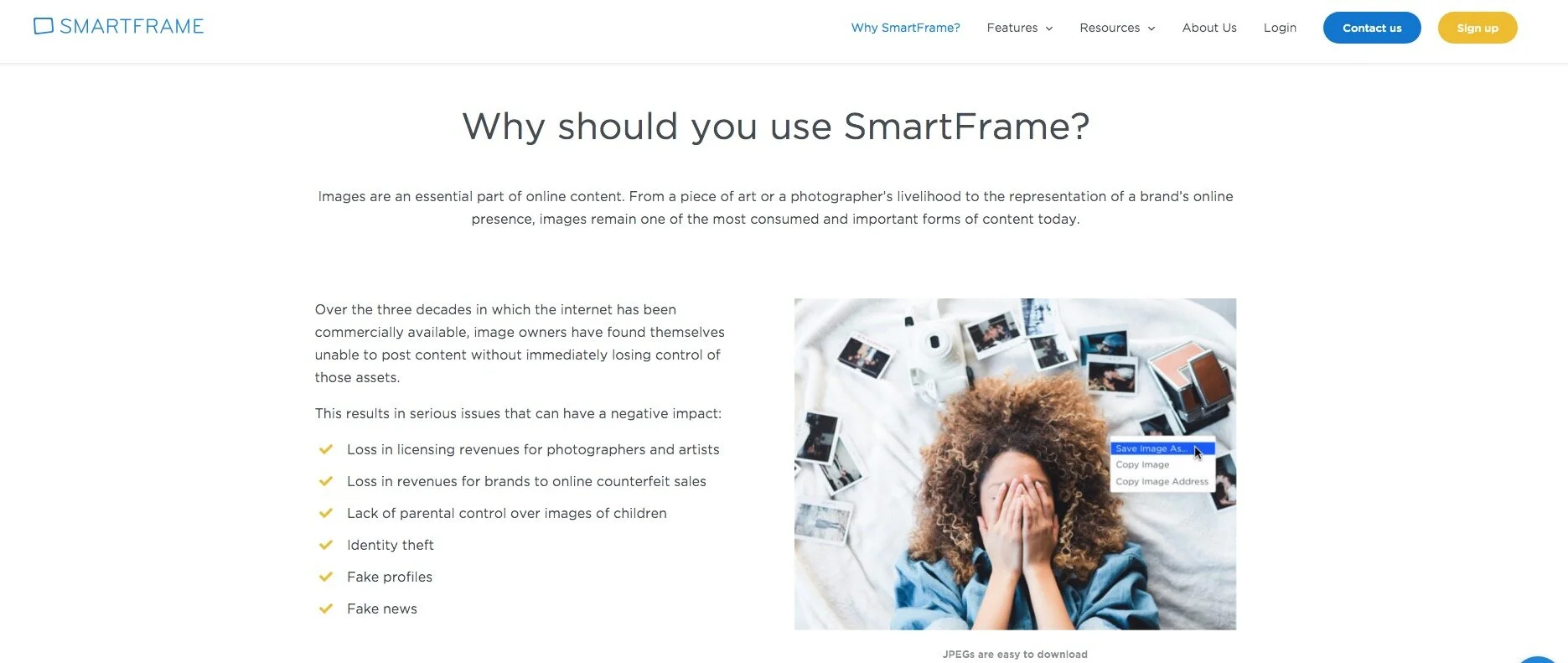
5) Use Smartframe Technology

I use Smartframe technology and services to protect and share images. SmartFrame is the ultimate platform for optimizing, securing and presenting your online images, with enhanced tracking and monetization tools. Check here https://smartframe.io/


Screen Shot 2019-11-22 at 19.02.44.jpg