Marco Secchi
  • Marco
  • Venice
  • Budapest
  • Transylvania
  • Prague
  • Slovenia
  • Contact
  • Substack
  • Visual
Marco Secchi
  • Marco/
  • Venice/
  • Budapest/
  • Transylvania/
  • Prague/
  • Slovenia/
  • Contact/
  • Substack/
  • Visual/
DSCF5035 copy.jpg
Marco Secchi

Ramblings of a Confused

“Rambling of a Confused” is the blog of award winner photographer and visual storyteller Marco Secchi

Marco Secchi
  • Marco/
  • Venice/
  • Budapest/
  • Transylvania/
  • Prague/
  • Slovenia/
  • Contact/
  • Substack/
  • Visual/
December 18, 2012

Rolleiflex Automat MX 3.5

December 18, 2012/ Marco Secchi

Rolleiflex Automat (X sync.) is a medium format TLR film camera manufactured by Franke & Heidecke, Braunschweig, Germany, and produced between 1949-51.Rolleiflex 3.5 MX-EVS
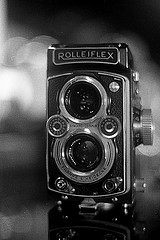
Automat (X sync.) is also known as Model Automat MX 3.5

All Rolleiflex Automat series was produced between 1937-1956. Mine is 1954.

Automat name stands to introduced automatic film counter in 1937; this counter senses the thickness of the film backing to accurately begin counting frames, obviating the need for the ruby window that forced the photographer to read the frame number off the back of the film itself. Rolleiflex TLR film cameras were most famous and the standard of news and studio photographers for decades. Many photographers still shoot with Rolleiflex TLR film cameras and black-and-white film.

Rolleiflex is the name of a long-running and diverse line of high-end cameras originally made by the German company Franke & Heidecke, and later Rollei-Werk. The "Rolleiflex" name is most commonly used to refer to Rollei's premier line of medium format twin lens reflex (TLR) cameras. (A companion line intended for amateur photographers, Rolleicord, existed for several decades.) However, a variety of TLRs and SLRs in medium format, and zone focus, and SLR 35 mm, as well as digital formats have also been produced under the Rolleiflex label. The 120 roll film Rolleiflex series is marketed primarily to professional photographers. Rolleiflex cameras have used film formats 117 (Original Rolleiflex), 120 (Standard, Automat, Letter Models, Rollei-Magic, and T model), and 127 (Baby Rolleiflex).

The Rolleiflex TLR film cameras were notable for their exceptional build quality, compact size, modest weight, superior optics, durable, simple, reliable mechanics and bright viewfinders. They were popular and widely imitated. The high-quality 8 cm focal length lenses, manufactured by Zeiss and Schneider, allowed for a smaller, lighter, more compact camera than their imitators, The highly regarded Zeiss Planar f2.8 and Schneider Xenotar lenses, both 80mm focal length and fast in comparison, are both state of the art optics. Unique to the Rolleiflex Automat and letter model cameras, the mechanical wind mechanism was robust and clever, making film loading semi-automatic and quick. This mechanism started the exposure counter automatically, auto-spaced the 12 or 24 exposures, and tensioned the shutter; all with less than one full turn of the film advance crank. This makes the Rolleiflex Automat/Letter model cameras very sought-after for shooting fast paced action, such as street photography. A wide range of accessories made this camera a system: panorama head, sun shade, parallax-corrected close-ups lenses, color correction, contrast enhancing, and special effect filters, all mounted with a quick release bayonet, as well as a quick-change tripod attachment. Some amateur and fine-art photographers still shoot Rolleiflex TLR film cameras with color transparency, color negative, or black-and-white film. The later f2.8 and f3.5 letter models (Planar or Xenotar lens) are highly sought after in the used market, and command the greatest price. Rolleiflex TLRs are still manufactured in Germany by DHW Fototechnik.Historically there were five focal length cameras available including 5.5 cm Rollei-Wide, 6.0 cm Baby Rollei, 7.5 cm (f:3.5), 8.0 cm (f2.8), and 13.5 cm (f:4 Zeiss Sonnar) Tele-Rolleiflex. Although all Rolleflex cameras can be fine user cameras, there is also an active market for many Rolleiflex models as collectables, and this adds (greatly in some models) to the end price paid, particularly in Japan

December 18, 2012/ Marco Secchi/ Comment
My Gear
Braunschweig, Germany, Rollei, Rolleiflex, Rolleiflex TLR, Single-lens reflex camera, Toll-like receptor, Twin-lens reflex camera

Marco Secchi

Fine art, commercial and editorial Photographer | Director of Photography | Digital Content Creator | Photography Consultant | Innovation Leader |

  • My Fuji Travel Kit
  • On the trail of Tintoretto
  • Marco/
  • Venice/
  • Budapest/
  • Transylvania/
  • Prague/
  • Slovenia/
  • Contact/
  • Substack/
  • Visual/

Marco Secchi

One of the BestTours on Tripadvisor. Photo Workshop. Have you ever walked on the streets and saw a moment that you wanted to capture, but you were too scared to take the photograph? Do you want to become more confident shooting in the streets and learn how to better interact with your subjects? 

Info, News and updates about Venice. Where to stay, What is happening, Where to Eat….and a lot more

Get Updates from Me!


My Instagram Feed

Two nuns observe a service at the Basilica di Santa Maria della Salute in Venice, framed by the baroque arches and marble floor of the historic church, Italy.
Nothing moves out here in winter, not even time. 

Leica loves this weather.
Nothing moves out here in winter, not even time. Leica loves this weather.
A terrible reminder of all wars

Asiago, Italy, November 28, 2025: Commemorative slab near the entrance to the Sacrario Militare del Leiten in Asiago, bearing the inscription “Tu che vivi in tempo di pace non ti scordare di noi,” meaning
A terrible reminder of all wars Asiago, Italy, November 28, 2025: Commemorative slab near the entrance to the Sacrario Militare del Leiten in Asiago, bearing the inscription “Tu che vivi in tempo di pace non ti scordare di noi,” meaning “You who live in a time of peace, do not forget us.” The memorial area, marked as a “Zona Sacra,” forms part of the First World War remembrance sites on the Asiago Plateau.
The sea was restless, so I slowed it down.
A few seconds of motion, and the Adriatic turned into soft lines of winter light.
The sea was restless, so I slowed it down. A few seconds of motion, and the Adriatic turned into soft lines of winter light.
Red walls worn by salt and time, a block of bright blue cutting in from the side, and a pale sheet drifting like a sail between them. A woman walks past the cracked texture, and another leans out to wrestle the laundry.
Nothing dramatic, just Burano
Red walls worn by salt and time, a block of bright blue cutting in from the side, and a pale sheet drifting like a sail between them. A woman walks past the cracked texture, and another leans out to wrestle the laundry. Nothing dramatic, just Burano doing its quiet theatre of colour and routine. Today with @glendiebro in Burano!
The day after La Salute feels like Venice catching its breath. 

Fewer crowds, more wax, and a small army tidying up the traces of a long, glowing night.
The day after La Salute feels like Venice catching its breath. Fewer crowds, more wax, and a small army tidying up the traces of a long, glowing night.

Made with ❤️ in Venice and Budapest

Images Copyright by Marco Secchi