The Makara from Saint-Jean-Cap-Ferrat
Some objects in The Cabinet come with a history. Others come with a question.
This one has been a question for nearly thirty years.
I bought it in Saint-Jean-Cap-Ferrat in the 1990s, from a dealer specialising in Asian antiques. At the time, Saint-Jean and Monaco were not holiday destinations for us. We lived in the area for five or six years. Nice, Monaco, Beaulieu, Villefranche and Saint-Jean were simply our territory, places we knew and moved through as part of ordinary life.
And, as has happened rather too often in my life, ordinary life included looking in the windows of antique shops.
I don't remember going into the shop looking for anything in particular. I rarely did. What I do remember is this extraordinary creature.
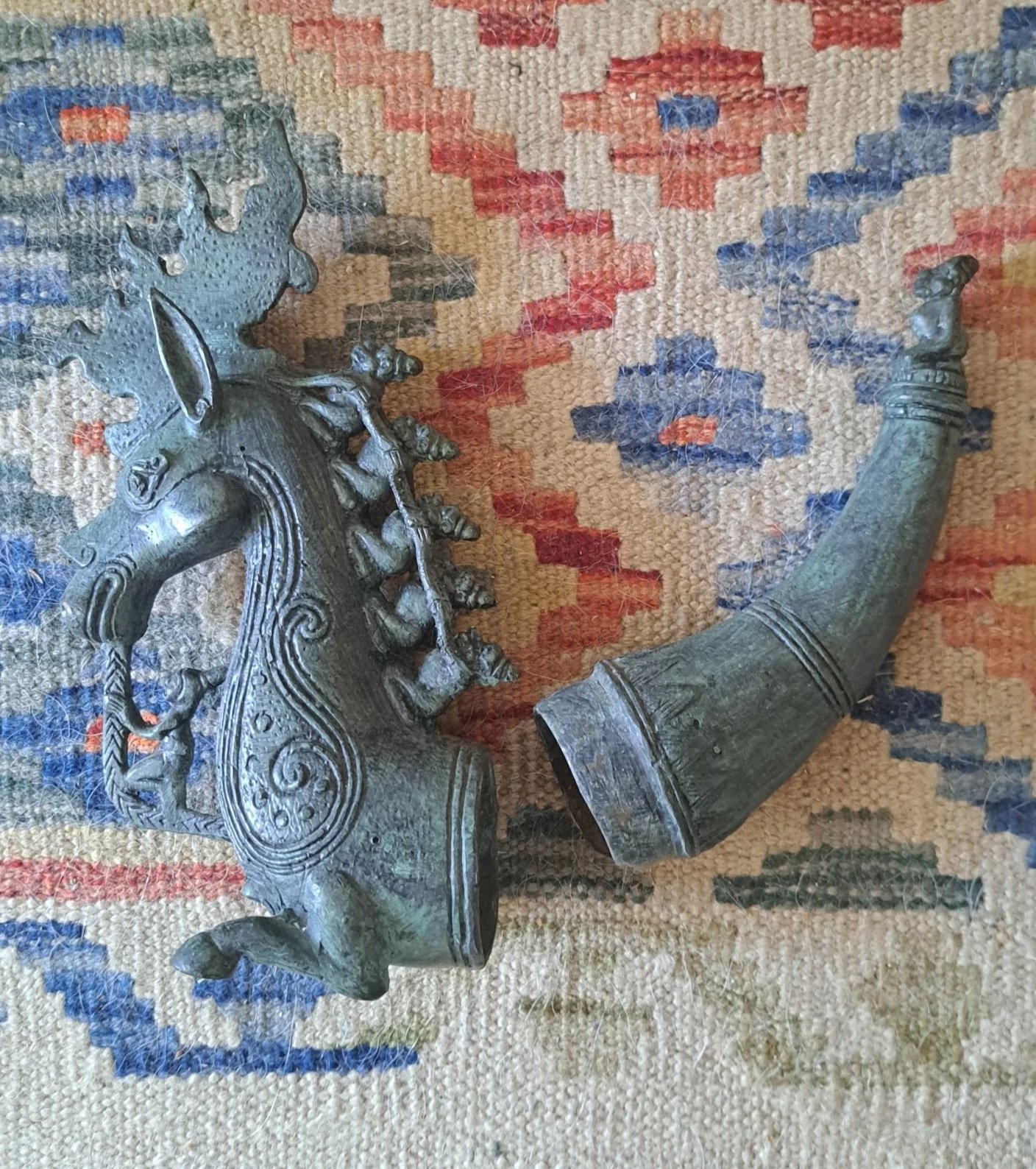
For years I thought of it as a dragon. That was the obvious description. It has a long snout, enormous ears, a spectacular crest rising from its head and a row of strange projections running down its neck. Something smaller seems to emerge from, or be held by, its mouth. Behind all of this, the body turns into a long curved horn.
It looked slightly ridiculous, slightly ferocious and completely irresistible.
So it came home with me.
Only much later did I begin to understand that “dragon” was probably the wrong word.
The creature appears to belong to the enormous family of representations of the makara, one of the great composite creatures of Hindu and Buddhist art. A makara is deliberately difficult to describe because it was never intended to correspond to a real animal. Depending on period and region, it can combine characteristics of crocodiles, elephants, fish, serpents and other creatures. It belongs particularly to water, appearing in sculpture and architecture and frequently associated with entrances, temples and the movement or pouring of water.
That last connection makes this object particularly interesting.
This is not simply a bronze sculpture.
The body is hollow. The long curved section at the rear is also hollow and detachable, fitting into the body of the creature. The construction strongly suggests that the object had a practical function involving liquid, perhaps as a ritual vessel, pouring device or elaborate spout. Makara-shaped water spouts and ritual vessels are known from both South and Southeast Asia, including Indonesia.
Exactly what mine was used for is harder to establish.
And that is where I prefer the story to remain honest.
There are features that make a Southeast Asian origin, possibly Indonesian or Javanese, particularly tempting. There are also related traditions in India and elsewhere across the Hindu-Buddhist world. Similar forms can be very old indeed, but the survival of an ancient design does not make every object carrying that design ancient.
I therefore don't believe there is enough evidence to confidently date this makara to the medieval period.
The bronze itself tells us something. At approximately 1.5 kilograms, it is substantial. It is cast rather than made from thin sheet metal, and the irregularities visible inside the hollow body are consistent with traditional casting. The surface has acquired a dark brown-green patina, with areas of green copper corrosion. The decoration is integral to the casting rather than simply applied to the surface.
There are also wonderful little details that become apparent only when you handle it.
The sweeping lines cut into the neck suggest water or curling vegetation. The great crest is covered with tiny punched marks. The row of projections along the back almost turns the creature into a miniature piece of architecture. Then there is the small figure curling upwards beneath the snout, apparently disappearing into the makara's mouth.
Nothing about it is restrained.
That is probably why I bought it.
For the moment, I would place it cautiously somewhere around the 18th or 19th century, while accepting that it could prove earlier if a convincing comparison or scientific examination eventually gives us better evidence. I would rather leave a century unresolved than invent one because it makes a better story.
There is another part of its history, however, that I do know.
For roughly thirty years it has followed me.
When I bought it on the Côte d'Azur I certainly wasn't thinking about a collection called The Cabinet. There was no collection. There was just an object in an antique shop that I couldn't quite leave behind.
Apparently that has been my collecting system for most of my life.
And perhaps that is why this makara belongs here more than almost anything else.
I still don't know exactly who made it. I don't know where it originally stood, what passed through its hollow body, or how it travelled from Asia to an antique shop in Saint-Jean-Cap-Ferrat.
I only know where our part of the story begins.
In a shop I used to pass on what was then our home ground, with a strange bronze creature that I thought was a dragon.
Thirty years later, I finally know its name.
Or at least, I think I do.
THE OBJECT
Object: Makara-shaped ritual vessel or spout
Probable date: 18th–19th century, possibly earlier
Probable origin: South or Southeast Asia, possibly Indonesia / Java
Material: Cast bronze / copper alloy
Dimensions: 26 × 22 cm
Weight: Approx. 1.5 kg
Construction: Hollow cast body with detachable curved section
Acquired: Saint-Jean-Cap-Ferrat, France, c. 1990s
Provenance: Purchased from a dealer specialising in Asian antiques
Collection: The Cabinet
A note on attribution
Attribution: The identification as a makara is based on its composite animal form and comparison with makara-shaped vessels and water spouts from South and Southeast Asian traditions. The precise origin, function and date remain uncertain. I have deliberately kept the attribution broad until a closer parallel can be established
STATUS: COLLECTION
This object is currently not for sale.