A Gaucho’s Knife
There was a period in my life when I played polo.
Not particularly well, perhaps, but well enough for it to take me to Argentina several times around 1990. And if you play polo, sooner or later Argentina becomes rather difficult to avoid.
When I went there, I used to stay on an estancia outside Buenos Aires. It was a very different Argentina from the city. Horses, open country, polo and the people whose lives revolved around them.
That is where this knife came from.
It wasn't bought in an antiques shop, nor found years later at a market in Europe. One of the gauchos gave it to me.
At the time I didn't investigate it. There was no reason to. It was simply a gaucho knife, given to me in Argentina by someone for whom this kind of object belonged naturally to everyday life.
I brought it home and kept it.
More than thirty years later, while going through things for The Cabinet, I took it out again and started looking at it properly.
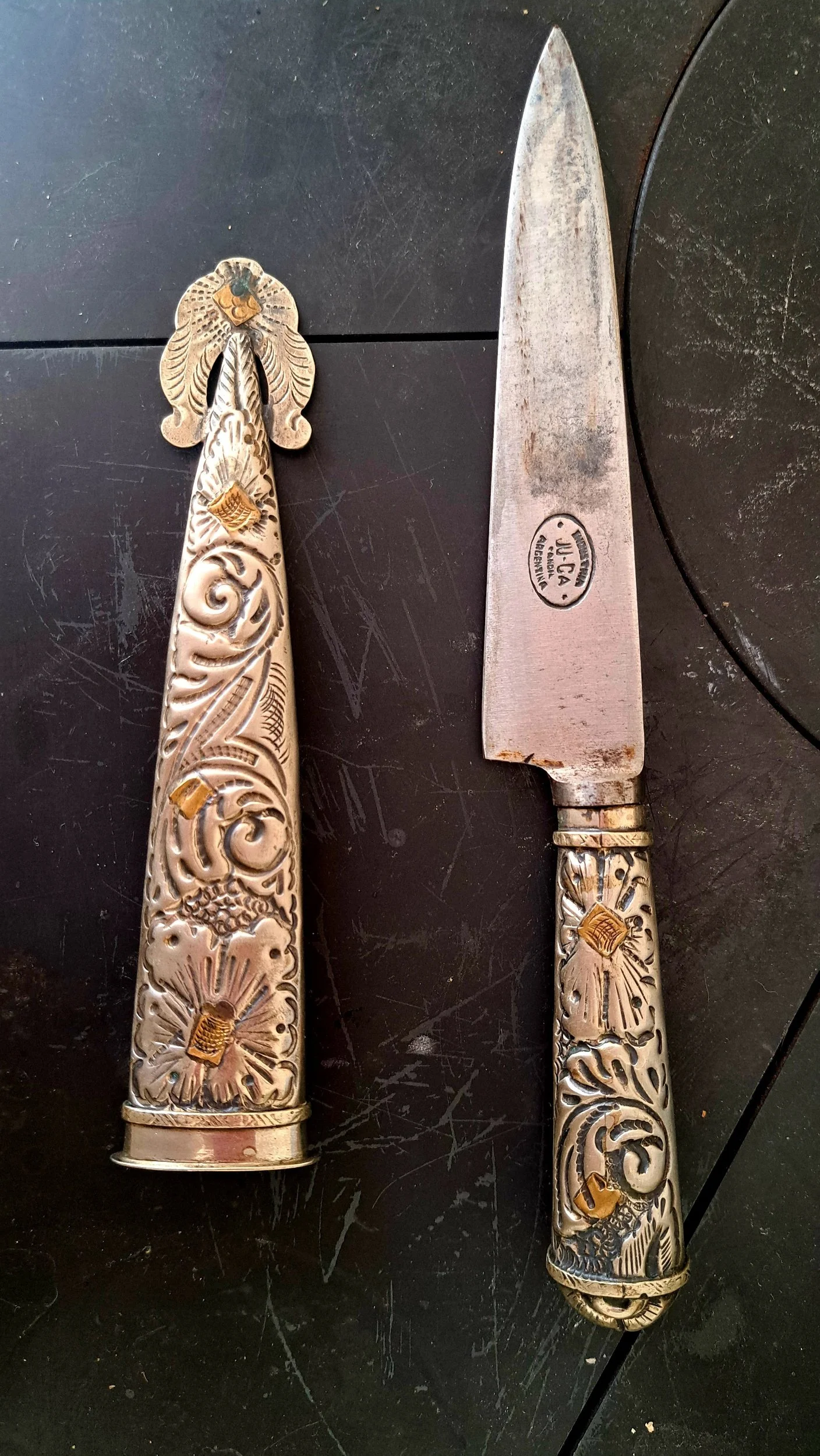
The first thing that catches your attention isn't the blade at all. It is the sheath.
The white metal is heavily decorated with flowers and geometric patterns, with small contrasting yellow-metal details. The handle continues the same decoration. It has all the visual language we associate with the traditional Argentine gaucho knife.
The blade, by comparison, is almost austere.
And on that blade is a small stamp that I had never paid much attention to.
JU-CA. TANDIL. ARGENTINA.
That little mark gave the knife another piece of its history.
JU-CA is a knife maker associated with Tandil, a city in Buenos Aires Province with a long tradition of Argentine knife making. The company dates from the second half of the twentieth century and produced traditional criollo and gaucho knives, often combining steel blades with elaborate alpaca fittings.
Alpaca is important here because, despite the appearance, the brilliant white metal used on many Argentine knives is not necessarily silver. Alpaca, an alloy of copper, nickel and zinc, was extensively used for gaucho knives, mate equipment and horse fittings because it could be worked and decorated like silver at a fraction of the cost.
Unless testing proves otherwise, that is probably what covers the handle and sheath of this knife.
It would also be easy to make the knife older than it really is.
Its decoration belongs to a tradition that stretches back generations, but traditional design is not proof of age. Because JU-CA is a twentieth-century manufacturer and I received the knife around 1990, I would place this particular example somewhere in the second half of the twentieth century.
And that is perfectly fine.
The Cabinet isn't supposed to be a competition to see which object is oldest.
What matters to me is that this knife has never been separated from the circumstances in which I received it.
I can look at it now and immediately find myself back on an estancia outside Buenos Aires, at a time when I was travelling to Argentina to play polo. Horses instead of cameras, although knowing me there was probably a camera somewhere as well.
The knife also reminds me of something easily lost when objects enter collections.
Before they become “collectibles”, objects have lives.
A gaucho knife is part of a much older Argentine rural tradition. It could be used for cutting meat, leather, rope and any number of ordinary jobs around horses and cattle. Larger knives, particularly the facón, eventually acquired an almost mythological status through gaucho literature and popular culture.
Mine is better described as a cuchillo criollo, part of that broader tradition rather than one of the great fighting facones of the nineteenth century.
But none of that was what mattered when it was handed to me.
It was a knife from a gaucho.
I accepted it, took it home and kept it for more than thirty years.
Only now have I bothered to read the little name stamped into the steel.
Sometimes research uncovers a spectacular history.
Sometimes it simply tells you who made something you already valued for completely different reasons.
I think I prefer the second kind.
THE OBJECT
Object: Argentine gaucho knife / cuchillo criollo
Maker: JU-CA
Origin: Tandil, Argentina
Probable date: Second half of the 20th century, before c. 1990
Material: Steel blade; decorated white-metal mounts, probably alpaca, with yellow-metal details
Acquired: Argentina, around 1990
Provenance: Given to me by a gaucho while staying on an estancia outside Buenos Aires during one of several trips to Argentina connected with playing polo
Collection: The Cabinet
STATUS: COLLECTION
This object is currently not for sale.